
By Kevin Rademeyer, Sports Journalist.
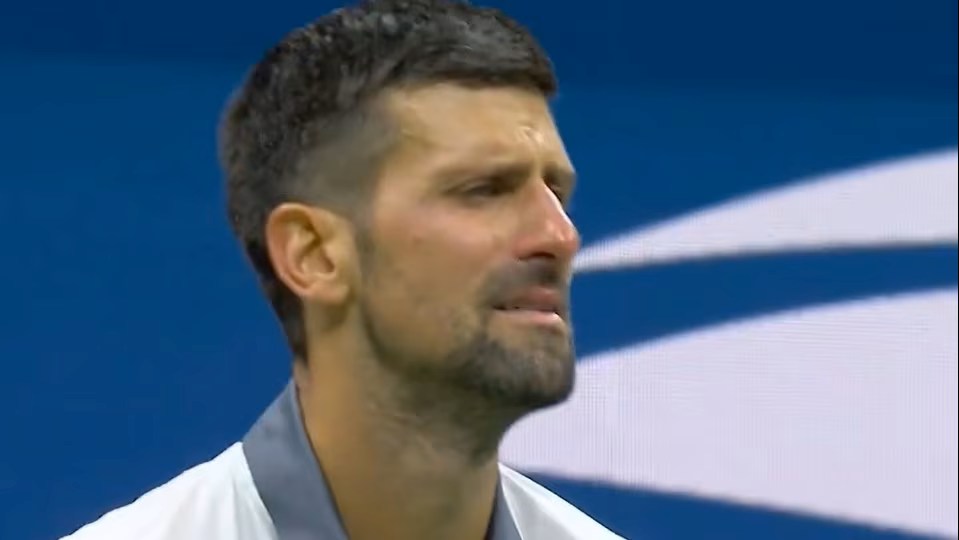
Photo Credit: Djokovic at US Open 2026. (Screengrab from X).
Novak Djokovic’s 84th Grand Slam appearance ended with him bent over a towel bin on Arthur Ashe Stadium, vomiting as the first night session of the US Open drifted towards its third hour.
By midnight, after four hours and 36 minutes of tennis and physical distress, the 39 year old Serb was in tears. Mariano Navone, the Argentine who grew up idolising him, had completed one of the biggest wins of his career, prevailing 7 6 (7 5), 5 7, 4 6, 6 2, 6 1.
It was Djokovic’s earliest Grand Slam exit in more than 20 years.
The last time he lost in the opening round of a major, he was an 18 year old at the 2006 Australian Open. This was only the third first round defeat of his career, and it came in circumstances that made the result difficult to separate from the physical ordeal unfolding on court.
Djokovic’s problems began almost immediately. Barely 15 minutes had passed when he was already struggling with the humid New York air. After breaking Navone for a 2 0 lead, he began coughing and spluttering behind the baseline, repeatedly bending over as he tried to recover.
At 4 3, rain forced the roof over Ashe to close. The conditions remained uncomfortable, but there was a striking contrast between the two players. Navone carried on with little visible difficulty. Djokovic repeatedly covered himself with ice soaked towels and, at 5 4 in the opening set, received medication from the doctor.
The Serb kept fighting.
That has been the Djokovic story for much of his career, but there was a limit to what even he could extract from his body on this occasion. He vomited several times, struggled for balance and, from the fourth set onwards, began battling cramps.
“I think it was obvious that it was an awful feeling on the court for me,” Djokovic said afterwards. “It is something that I’ve been carrying, unfortunately, pretty much every match this year.”
He described vomiting and then feeling his body begin to collapse, with cramping and pain spreading through his back and shoulder. “I couldn’t close it out, break up in the fourth, but just struggled all the way since the fourth game of the match,” he said. “I didn’t enjoy myself.”
There was no attempt from Djokovic to diminish Navone’s achievement. He called him a nice guy and a fighter, and acknowledged that the Argentine deserved the victory.
Navone certainly played his part.
The 25 year old has rebuilt his ranking after coming close to slipping outside the world’s top 100 last year and has established himself inside the top 50. Much of his best tennis, however, had come on clay. Against Djokovic on a hard court in New York, this was supposed to be an opportunity for the 24 time Grand Slam champion to negotiate a manageable opening round and preserve energy for the fortnight ahead.
Instead, Navone found himself facing a wounded opponent and did not waste the opportunity.
He chased everything. His groundstrokes carried consistent depth and he repeatedly dragged Djokovic into long exchanges, asking questions of legs that were already beginning to fail. There was nothing spectacular about the Argentine’s approach. It was disciplined, stubborn and relentless.
For Navone, there was something else at stake. Djokovic had been his idol since childhood. After the draw was made, old social media posts from 2014 emerged showing the teenage Navone repeatedly supporting the Serb. His parents had not even planned to attend this year’s US Open. The draw changed that. They abandoned a Caribbean holiday and flew to New York.
They got to witness the biggest victory of their son’s career.
For a while, Djokovic’s serving kept the match alive. Even as his movement deteriorated, he found enough accuracy and pace on the first delivery to stay competitive. He somehow took the third set and appeared to have created another escape route.
But the margin was disappearing. By the fourth set his first serve began to falter, his legs looked increasingly heavy and the cramps became another opponent. Navone sensed it and continued to extend the rallies.
Djokovic still refused to go quietly.
That is why the defeat felt so stark when it finally arrived. There was no sudden collapse in the scoreline, no single spectacular passage that explained everything. It was a long, uncomfortable wearing down of one of the greatest players the sport has known.
When the final ball was struck, Djokovic walked towards the locker room in tears.
The US Open has seen him survive extraordinary nights before. This time, there was nothing left to summon.
For Navone, there was only the celebration, and perhaps the strange reality of having beaten the player whose name once filled his teenage social media feed.
For Djokovic, New York delivered a reminder that longevity has its price. At 39, even the most formidable reserves are no longer guaranteed to be there when the body begins to give way.