
By Kevin Rademeyer, Sports Journalist.
Photo Credit: SA Rugby.
There is something fitting about the trophy that will be contested when the Springboks and All Blacks meet at Ellis Park on Saturday. It is not one trophy, at least not yet. It is two.
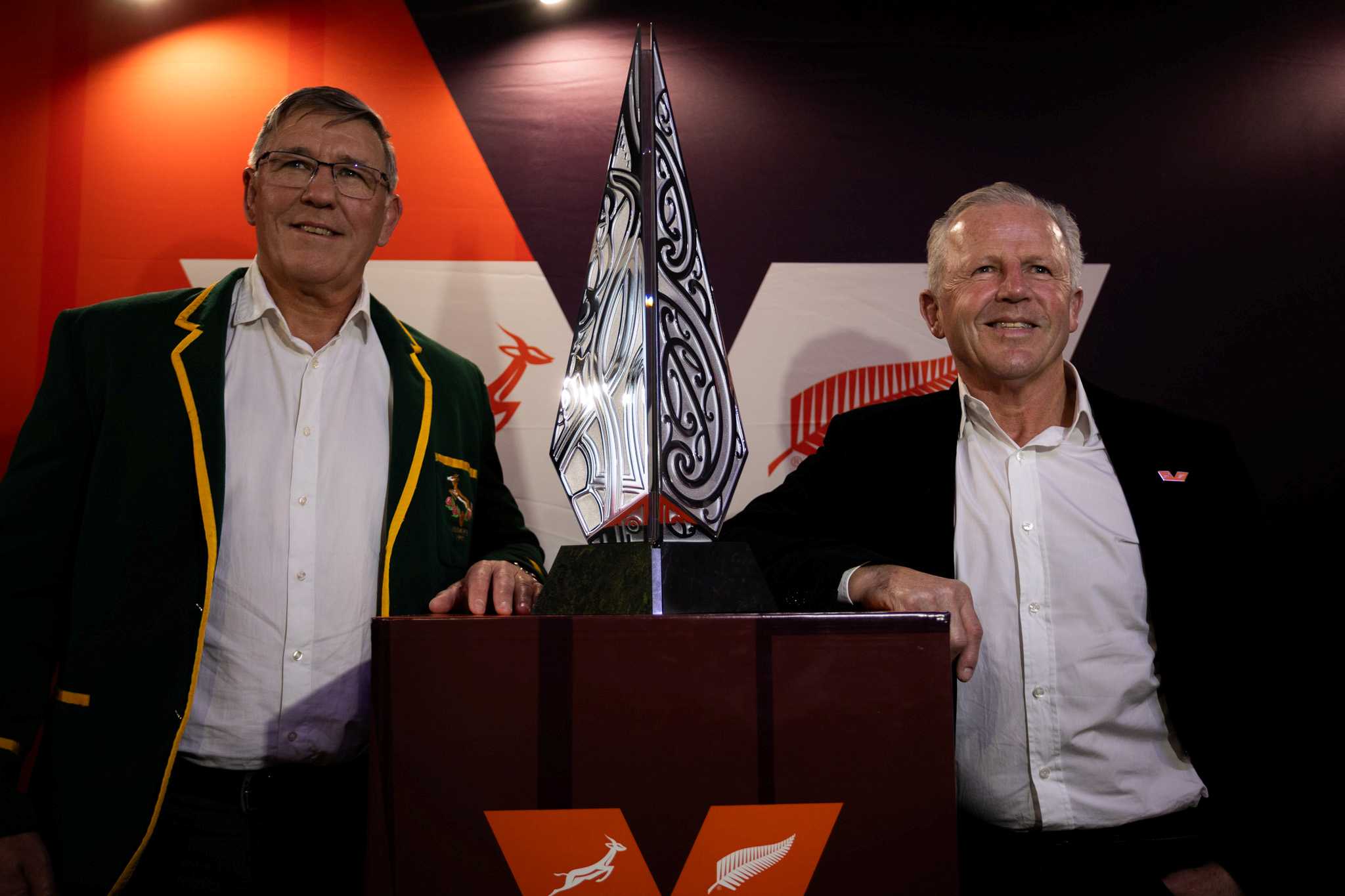
Two blades of luminium, each standing alone, one representing South Africa and the other New Zealand. Yet bring them together and hidden magnets pull them into a single piece of silverware.
The South African blade features artwork by Bonolo Chepape, whose work explores the idea that greatness is never achieved alone. Through layered patterns inspired by community, culture and shared experience, her artwork celebrates the many people who shape sporting excellence in South Africa.
The New Zealand blade carries artwork by Kereama Taepa, inspired by the Māori creation story of Tāne and Whiro , two brothers whose rivalry sees them pursue the same goal by different paths. His work reflects the tension, respect and connection that sit at the heart of great rivalries.
It is an unusually clever piece of design for an unusually stubborn rivalry. For more than a century these two rugby nations have tried to separate themselves from one another, only to find that the history of one is impossible to tell without the other.
Now, after years without a traditional tour of this scale, the rivalry returns with four Tests, beginning in Johannesburg, and the sense of anticipation is already considerable.
The trophy was unveiled in Johannesburg by two men who know precisely what this rivalry can demand: Springbok captain Gary Teichmann and All Blacks captain Sean Fitzpatrick, the respective leaders when the teams met in the famous 1996 series.
For Fitzpatrick, that tour remains the defining achievement of his career. Speaking to Fullview South Africa Sean said “We won the World Cup in 87. 95 was amazing, although we lost, that was an unbelievable match, at the World Cup. But ’96 for me, without question, is my greatest achievement. To beat my childhood heroes and to do it the way we did.” That tells you something about what Saturday means.
This is not simply another Test match. It is the opening move in a series that will run for four matches and 320 minutes of rugby. There will be momentum swings, selection gambles, tactical battles and, almost inevitably, moments when one team appears to have seized control only for the other to drag itself back into the contest.
That is what these matches tend to do. The first two tours, in 1921 and 1928, were both shared. And if this series finishes 2 2, the new trophy will be divided between the two nations, each retaining its half.
Rian Oberholzer, CEO of SA Rugby, said that possibility was central to the thinking behind the design. “If each team has won two Tests at the end of 320 minutes of intense rugby, it seemed inappropriate to decide a winner on an arbitrary metric,” he said.
Steve Lancaster, CEO of New Zealand Rugby said: “The trophy is a really fitting way to recognise what this rivalry is about. It’s something different and unique, and importantly, it tells the story of two teams and two countries that have been competing against each other for more than 100 years.”
That is a wonderfully simple explanation for a rivalry that has rarely been simple. No player knows that better than Gary Teichmann knows the other side of the story, and is still dealing with the ghosts of 1996.
He had played only six Tests before leading the Springboks into the 1996 series. Francois Pienaar, the captain who had lifted the World Cup the year before, was injured. It was a baptism of fire. “We lost, but we showed great heart in coming back in the last Test at Ellis Park,” Teichmann recalled.
Almost three decades later, the lessons remain familiar. “I believe the Springboks have done a phenomenal job,” he said, crediting South African rugby and Rassie Erasmus, whom he described as “a student of the game”.
And if anyone understands the importance of preparation, it is Erasmus. The Springbok coach has described this series as being almost like the knockout stages of a World Cup. That is not rhetoric for the sake of a headline. Four Tests against the All Blacks, with the first at Ellis Park, the second in Cape Town and two more to follow in Johannesburg and Baltimore, leave very little room for recovery once momentum is lost.
Fitzpatrick knows that better than most. “The first Test is paramount, as Gary found out,” he said. That sentence carries more weight than a prediction ever could. The opening Test could shape everything
The All Blacks arrive at Ellis Park unbeaten on tour after wins over the Stormers, Sharks and Bulls. Their attacking game has been impressive, particularly in the way they have moved the ball and punished defensive hesitation.
But there have also been warning signs. The Stormers pushed them hard. The Sharks had opportunities before collapsing after half time. The Bulls exposed moments when New Zealand were willing to take risks from deep in their own half.
Dave Rennie knows that the Springboks will offer an entirely different examination. “We know that the intensity level, the quality that we’re going to come up against next week is, you know, three, four, fivefold,” Rennie said after the victory over the Bulls. That may be the most important sentence surrounding Saturday’s Test.
New Zealand have looked good. They have not yet been asked to look exceptional for 80 minutes against the world’s best team. The Springboks, meanwhile, have had time to prepare, recover and build towards this moment.
Rassie Erasmus has made that clear. “It will undoubtedly be a very challenging series, but we are looking forward to it as a collective,” he said, adding that the team had been working behind the scenes while the wider squad completed its recovery.
The All Blacks will bring speed, ambition, desire and a willingness to attack from almost anywhere.
South Africa will bring something different. Pressure. Physicality. The ability to turn five metres of territory into seven points, and to turn a close game into a Test of nerve.
Teichmann believes the margins will be tiny. “The games are always going to be close,” he said. “Every player, whether they’re on the bench or just a squad player, will have a pivotal role.”
That may ultimately be the story of this series. Not the superstar. Not the captain. Not even the coach. The player who comes off the bench with 20 minutes remaining when the game is hanging by a thread. The prop who wins one scrum. The winger who makes one tackle. The flyhalf who chooses to kick when everyone expects him to run.
The final Test is in Baltimore on 12 September. By then, the two halves of the trophy may have been re-united, and one nation will be celebrating. But before that happens, there is Ellis Park. And there is history.
For all the cleverness of the new trophy, nobody needed to design the magnetism between these two teams. That has existed for more than 100 years. Saturday simply gives them another reason to collide.