
By Lehlohonolo Lehana.
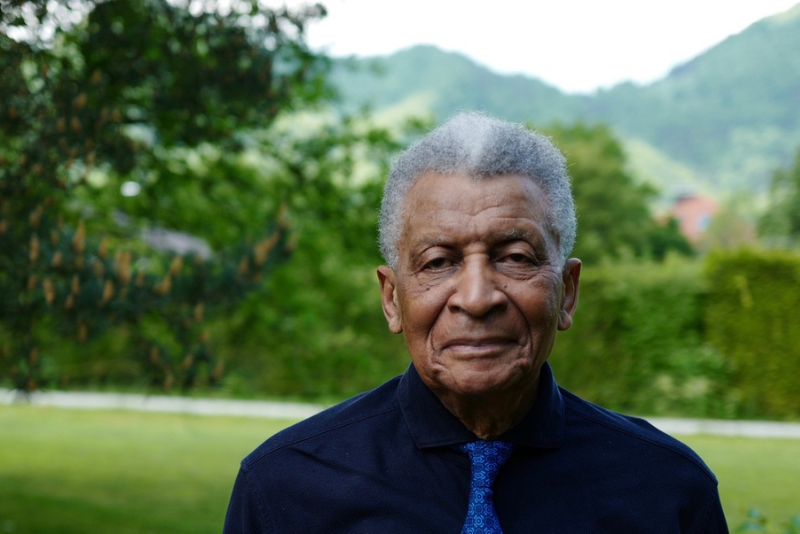
South Africa has lost one of the most influential voices in international jazz, Abdullah Ibrahim, who died peacefully in Germany on Monday after a short illness, surrounded by his family.
His family announced his death in a statement released on Monday.
“Abdullah passed away peacefully with South Africa and its people in his heart,” wrote his partner, Dr Marina Umari. “His love for his country never wavered, no matter where in the world he found himself.”
Ibrahim, born Adolph Johannes Brand in 1934, grew up in Cape Town and began composing at the piano at the age of seven by picking out tunes on the keyboard. He would go on to have a career that spanned eight decades and dozens of recordings.
Ibrahim, who was initially known on stage as Dollar Brand, changed his name after converting to Islam in the late 1960s.
He personified the special brand of multiple identities and belief systems, consolidated and transmitted over generations among a variety of descendants in the urban settings at the Cape.
His spirituality was not only a source of resilience but also defiance, his humanity political without any need for ideology.
In search of genuine expressions through music, he became an icon of a counter-world to the apartheid regime, taking sides by being and living up to what he was.
As a teenager, the pianist and composer played in a swing band, his own trio and then in a sextet called the Jazz Epistles, which also included another South African jazz great, Hugh Masakela.
As apartheid, which began to be legally enforced in 1948, became increasingly rigid, jazz music, which was seen as counter-cultural and encouraged racial mixing, was looked down on.
Ibrahim moved to Europe in the 1960s where he met Duke Ellington, who he went on to record with before he moved to New York in 1965. “I always say we never thought of Ellington as an African American – we thought of him as a wise old man in the village,” Ibrahim said in 2024. “You have any musical problem or inspiration, you go to Ellington. And he has been that bulwark for many, many, many musicians.”
Despite living outside South Africa, he never forgot his roots and made frequent trips to the country to perform and record.
His final live appearance came at the Cape Town International Jazz Festival less than three months ago, “where he once again captivated audiences with the artistry, grace and profound musical vision that defined his life’s work”.
His most known piece, Mannenberg, was recorded in 1974 and became known as a major anti-apartheid anthem. The sung inspired Nelson Mandela during his imprisonment.
“I realised at an early age that this system of apartheid was totally against the brain of everything because it was not just that they didn’t want you to record the music, it’s that they didn’t want you to think,” he said in 2017.
He played for Nelson Mandela on multiple notable occasions, including at Mandela’s presidential inauguration in 1994 and at the historic 1988 Central Park concert in New York commemorating Mandela’s 70th birthday.
Ibrahim also worked on a number of soundtracks for films such as the Claire Denis dramas No Fear, No Die and Chocolat.
Abdullah has over 100 albums and over 300 compositions to his name.
Tributes
President Cyril Ramaphosa has expressed his profound sadness at the passing of cultural activist, global jazz icon and Esteemed Member of the Order of Ikhamanga.
Ramaphosa said: “Today our nation mourns the passing of an international icon and global citizen whose profound creations honoured the South Africa that shaped his political commitment and musical brilliance.
“As we commemorate the 50th anniversary of the Youth Uprising, the passing of Abdullah Ibrahim reminds us of the then illegal benefit concert he organised in support of the liberation movement following the Uprising, as a demonstration of his commitment to our struggle.
“We give thanks for the many decades of his life that he devoted to his personal passion which he shared with humanity through his recordings and his appearances in clubs and concert halls throughout the globe.”
“He has enriched our lives with his musical gifts and his involvement in making the world a better place.”
Pete Letanka, a UK-based jazz pianist who worked with Ibrahim, said that his music, though traditional-sounding, was also deeply relevant to contemporary listeners.
“What makes it so beautiful is you’re faced with the reality of all the obscenities of the apartheid regime but he is still capable of writing music that moves people to tears, whether it’s ‘Maraba Blues’ or ‘Water From an Ancient Well’ or a call to arms like ‘Mannenberg.”
“He never needed to dazzle us with incredible technique. There was something so spiritual, so awakened within him.”
ActionSA Herman Mashaba said Abdullah Ibrahim was more than a musician. He was a cultural ambassador, a storyteller, and a custodian of South Africa’s rich and complex history. Through his piano, he gave voice to the hopes, struggles, resilience, and aspirations of generations of South Africans.
His iconic compositions, including the timeless Mannenberg, became the soundtrack of resistance, freedom, and national pride during some of the darkest chapters of our country’s history.
His music transcended borders, languages, and cultures, earning him international acclaim while never losing its deep South African soul.
His life reminds us of the power of art to unite people, challenge injustice, and preserve our collective memory. At a time when South Africa continues to grapple with division and inequality, his legacy stands as a powerful reminder that our shared humanity is always greater than our differences.
While the nation mourns the loss of a giant, we also celebrate a life lived with purpose, excellence, and unwavering dedication to his craft. His melodies will continue to inspire future generations long after the final note has been played.
“We will miss you, Abdulla. South Africans were privileged to welcome you home for what would become your final performance at this year’s Cape Town International Jazz Festival. Your return was a celebration of a remarkable life dedicated to music, culture, and the spirit of our nation.”
Ibrahim’s honours include the Order of Ikhamanga, an honorary doctorate from the University of the Witwatersrand, the South African Music Lifetime Achievement Award, and a 2019 NEA Jazz Masters Fellowship in Washington, DC. His burial will take place in the Bavarian town in Germany where he had made his home.