
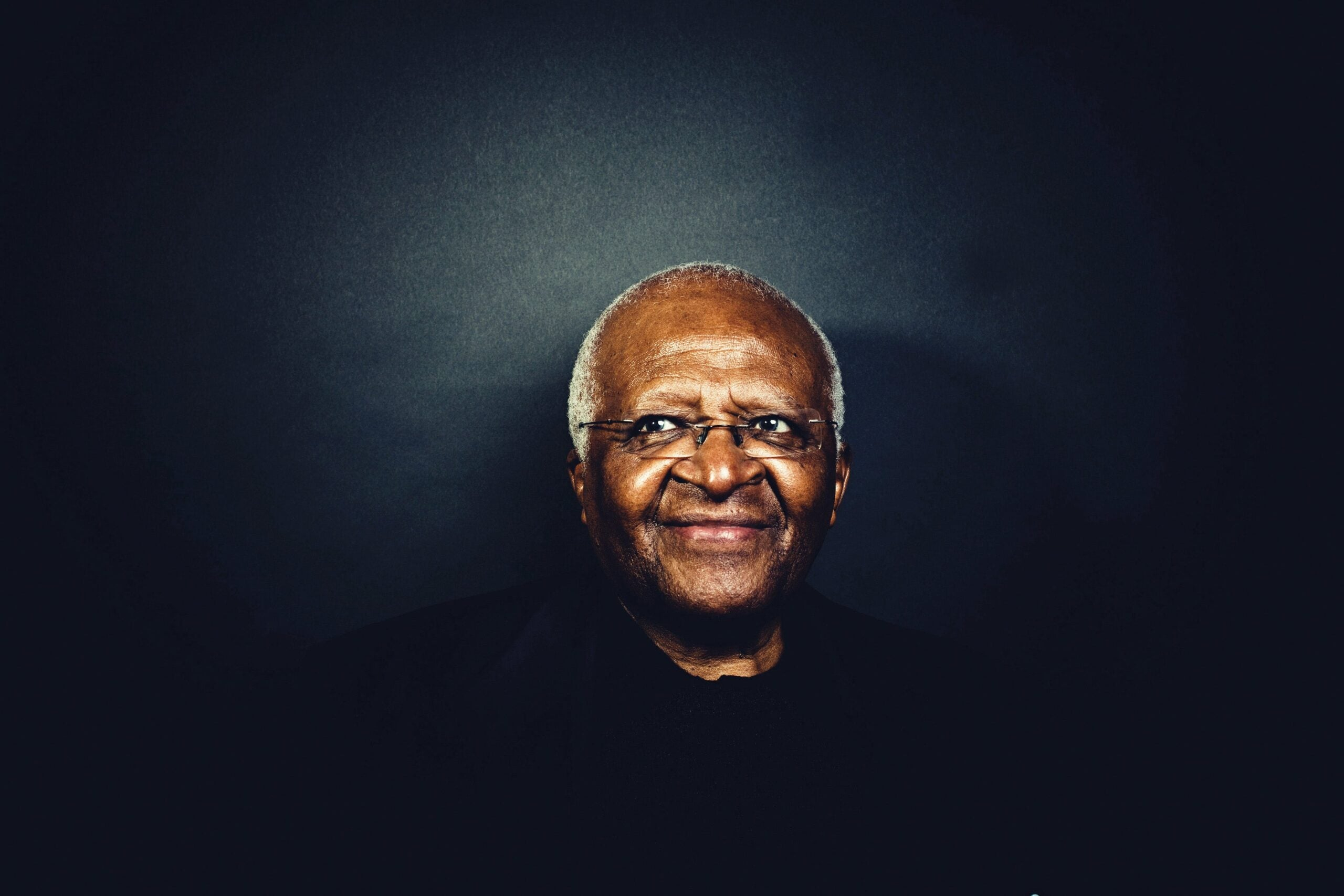
By Lehlohonolo Lehana.
Photo Credit: Stephen Voss.
Archbishop Emeritus Desmond Tutu has died at the age of 90.
Tutu, the last surviving South African laureate of the Nobel Peace Prize, died peacefully at the Oasis Frail Care Center in Cape Town.He had been hospitalized several times since 2015 after being diagnosed with prostate cancer in 1997.
A tireless social activist and human rights defender, Tutu not only coined the term “Rainbow Nation” to describe the country’s ethnic diversity but, after the first democratic elections in 1994, went on to become its conscience, using his international profile in campaigns against HIV/Aids, tuberculosis, poverty, racism, xenophobia, sexism, homophobia and transphobia, among others.
His was a powerful, forthright voice, one that irked both the Nationalist government and its successor, the African National Congress and its allies.
He was, an activist noted, “given to expressing his opinion in ways that are guaranteed to be outside the realm of comfortable politics”.
As Tutu himself put it, in 2007, “I wish I could shut up, but I can’t, and I won’t.”
It was that tenacity, particularly as an opponent of apartheid, that first catapulted the charismatic Tutu to prominence. With the ANC then a banned organisation and its leadership either exiled or imprisoned, the role of speaking truth to power was one that fell to community leaders like the clerics; as an Anglican archbishop, Tutu grasped the opportunity with dynamism that endeared him to many South Africans.
In 1986, at the height of PW Botha’s crackdown on dissent, Bishop Michael Nuttall, then head of the Natal diocese, explained Tutu’s role thus: “This dynamic, diminutive man has made himself available because others asked that he should, to be a light in the darkness and to help lead us into the dawn of a new day.”
Both at home and abroad, Tutu’s opposition to apartheid, which he often likened to Nazism, was vigorous and unequivocal. The Nationalists twice revoked his passport, and he was briefly jailed in 1980 after a protest march. Many felt that his increasing international reputation and his advocacy of non-violence had spared Tutu from more harsh treatment by the government.
He was a born orator and, according to the journalist Simon Hattenstone, “a natural performer [with] his hands and eyes flying all over the place, his voice impassioned and resonant; a tiny ball of love.”
In 1997, Tutu was diagnosed with prostrate cancer. He underwent lengthy and successful therapy in Cape Town and New York but otherwise continued his Truth and Reconciliation Commission (TRC) work. He was upbeat about his illness, telling Ebony magazine, “Yes, it would be nice to stick around a little longer. But I believe as a Christian that death is the end of one part, but the beginning of another. It’s like a doorway passing from one room of God’s wonderful world to another.”
Tutu retired as Archbishop of Cape Town in 1996 – whereupon he was promptly made emeritus Archbishop of Cape Town, an honorary title that is unusual in the Anglican Church. He continued to work as a global activist, on issues pertaining to democracy, freedom and human rights.
His friend, former President Nelson Mandela, went on to describe him as “sometimes strident, often tender, never afraid and seldom without humour, [his] voice will always be the voice of the voiceless”.
That voice was now however aimed squarely at the ANC as Tutu set about condemning the government for failing to deal with corruption, poverty and the xenophobic violence in the townships.
Tutu has received several awards for his humanitarian work, as well as numerous doctorates and fellowships from universities around the world. In addition to the Nobel Peace Prize, which he received in October 1984, he was awarded the Albert Schweitzer Prize for Humanitarianism in 1986, the Pacem in Terris Award in 1987, the Sydney Peace Prize in 1999, the Gandhi Peace Prize in 2007, and the US Presidential Medal of Freedom in 2009.
Desmond Mpilo Tutu was born in Klerksdorp, in the then Transvaal, on October 7, 1931, the only son of Zacheriah and Aletta Tutu’s four children. When he was 12, the family moved to Roodepoort, outside Johannesburg, where his mother found work as a cook at the Ezenzeleni School for the Blind.
He is survived by his wife, four children, seven grandchildren and great-grandchildren.