
By Kevin Rademeyer, Sports Journalist.
In the bowels of Hard Rock Stadium, Miami, where the light goes to die and optimism usually follows close behind, Iga Świątek stood for a moment like a prizefighter who had just discovered the canvas has a personality of its own. The corridor was narrow, the air stale, and the questions waiting. Before she faced them, she turned away, shoulders slightly hunched, and wiped her eyes. Not for show. Not for sympathy. Just to get on with it.
An hour earlier, she had taken a beating that did not show up cleanly on the scoreboard. Magda Linette had outlasted her in three sets at the Miami Open, but the real trouble was happening somewhere between Świątek’s ears, a place that used to be her safest neighbourhood. Now it feels like a construction site with no foreman.
“This is like the worst nightmare,” she said, and she did not dress it up. Champions rarely do when they are hurting properly. The shots are still there, the legs still churn, but the certainty has gone walkabout. Tennis, once simple as bread and butter, has become a chess problem with missing pieces.
So she did what players do when the map no longer matches the terrain. She changed something. Wim Fissette is out of the picture, another name in the long and sometimes thankless ledger of coaching exits. It is never just about the coach, of course. It is about timing, belief, and whether the player can hear instruction over the noise in her own head.
Świątek, still only 24, owns a résumé that would make a veteran blush. Six majors, four of them on the red clay of French Open, and enough weeks at number one to suggest permanence. Yet here she is, looking up at Aryna Sabalenka in the rankings and, more importantly, searching for that old, ruthless clarity.
The curious thing about greatness is that its strengths often carry the seeds of its trouble. Świątek built her empire on discipline, intensity, and a mind that rarely wandered. Now that same mind insists on examining every footstep before she takes it. The result is hesitation, and hesitation at this level is a hanging curveball.
There was the business with the contaminated medication, the enforced pause, the missed chance to chase the top ranking. Then, almost perversely, came liberation. With expectations lowered, she walked onto the lawns of Wimbledon and played like a woman who had misplaced her doubts. She won the title. Tennis will do that. It will hand you a masterpiece just when you are preparing a confession.
But the game has a long memory, and so do players. The tension crept back. Big matches became tightrope acts without a net. Around her, advisers talk, analysts analyse, and somewhere in that committee of voices sits the one that matters most, her own.
If Świątek is to find her way back to the summit, it will not be through a new forehand or a cleverer schedule. It will come when she stops negotiating with herself and starts deciding again. Champions do not eliminate doubt. They outvote it.
On the other end of the coin, Coco Gauff is busy staging a different kind of argument, one between what she has done and what she believes she deserves. She keeps winning, which is inconvenient when you are not entirely convinced you should be.
At the same Miami Open, on courts she has known since she was a child with a racket nearly as tall as she was, Gauff has been surviving rather than serenading. Three sets here, three sets there, and a quarter final that turned into a small act of endurance against Belinda Bencic. The scoreline read 6 to 3, 1 to 6, 6 to 3. The subtext read persistence.
“I think sometimes I can get impostor syndrome,” she admitted, which is not the sort of thing athletes used to say out loud. In the old days they would have blamed their shoes.
There is an arm that complains now and then, a serve under reconstruction, and the peculiar pressure of being a prodigy who has already cashed in on the promise. Two majors, including the US Open and the French Open, a cabinet full of titles, and still the nagging suspicion that she has wandered into someone else’s success.
Yet when the rallies stretch and the lungs begin to bargain, Gauff becomes exactly who her record says she is. She runs, retrieves, resets. She finds angles where there were none and belief where it seemed misplaced. Against Bencic she turned defence into offence with the sort of stubborn imagination that cannot be taught.
Her serve, that troublesome piece of machinery, held together well enough. A few aces, not too many double faults, and, more importantly, the courage to swing when the moment asked.
Next comes Karolína Muchová, a player with craft and timing and the sort of form that makes coaches nervous. Gauff leads their rivalry comfortably, which in tennis means almost nothing once the first ball is struck.
The calendar, as ever, is the silent antagonist. French Open is approaching with its slow burn and red dust, and Wimbledon sits less than a hundred days away, waiting with its clipped lawns and unforgiving truths. The tour moves on whether you are ready or not.
This is the part they do not put on the posters. The airports at odd hours, the hotel rooms that look alike after a while, the victories that feel fleeting and the losses that linger in the small hours. It is a travelling circus without a home ring, and even its stars can feel like stand ins.
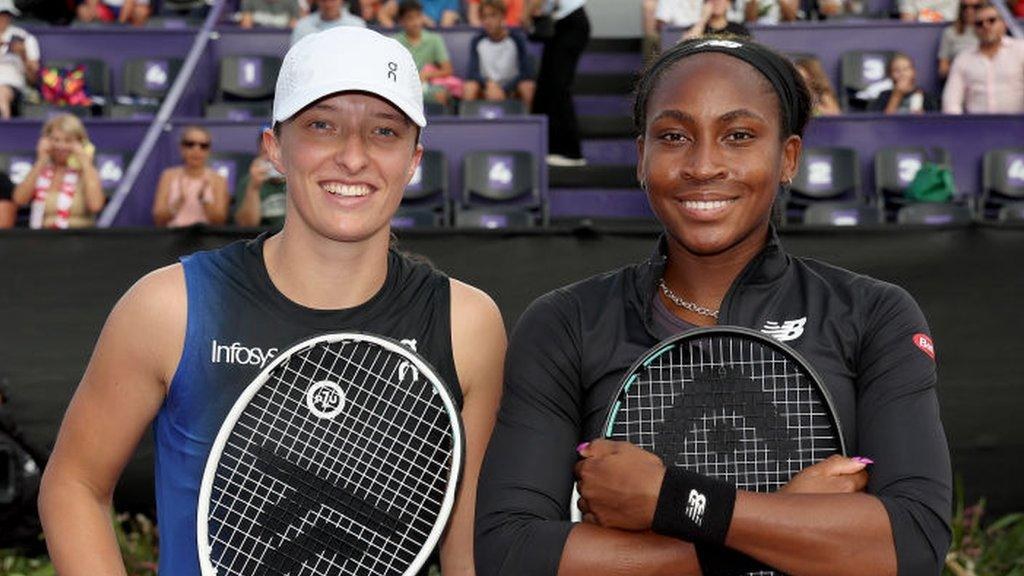
Świątek, the methodical champion with 25 titles and a place in history already secured, is trying to quiet a mind that has grown too loud. Gauff, the young American who announced herself at Wimbledon and never really left the conversation, is learning that belief does not always keep pace with achievement.
Both are chasing the same elusive thing. Not trophies. Not rankings. Something steadier. A way to walk onto the court, wherever it may be this week, and feel that the game still belongs to them.
Tennis has a way of revealing a person when the stakes are high and the margins thin. It is not always pretty. It is rarely quiet. But it is honest. And for Świątek and Gauff, honesty is where the next chapter begins.