
By Lehlohonolo Lehana.
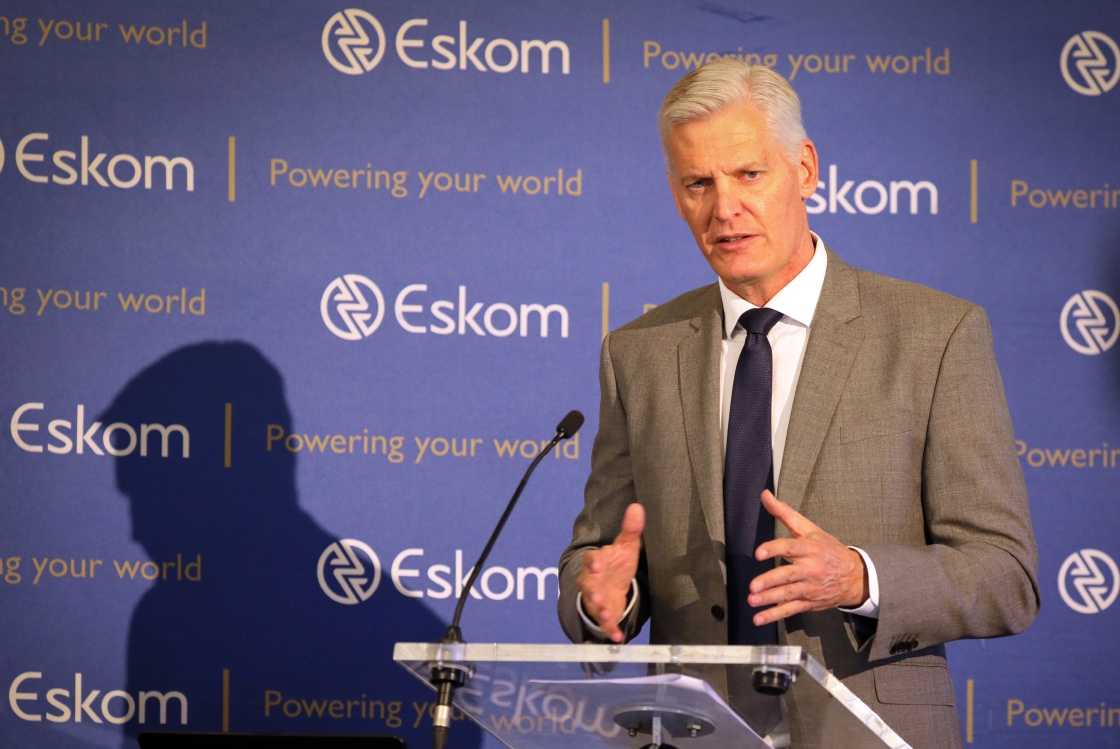
The Eskom board and outgoing CEO Andre de Ruyter appeared before Parliament for the first time this year as the country faces prolonged power cuts that could last for the next two years.
De Ruyter says the parastatal had identified Tutuka, Duvha, Majuba, Kusile, Matla and Callide power stations as the worst-performing plants.
He said Eskom’s EAF, which he described as unacceptable, was currently sitting at 56% and the power utility was focusing on improving the performance of the six power stations.
“We anticipate that we’ll be able to return 1 862MW to the grid by the end of March of this year. That’s more or less equivalent to two stages of load shedding.
“We furthermore intend to add 6 000 megawatts over the next 24 months, but we need the skill, money and time to enable us to do this work,” said De Ruyter.
“In order to make sure that there is no further slippage on this performance, we have to guard the performance at our current flagship stations Medupi, Lethabo and Matimba and our open cycle gas turbines and our pump storage plants, “he added.
De Ruyter said while they appreciate the extreme frustration caused to many South Africans by load-shedding, the damage to the economy and the impatience with finding urgent solutions, it was fair to point out that the current situation was not a new development.
He traced it back to 1998 when an energy white paper recorded that Eskom was asking for new capacity to be added urgently.
“In its wisdom, government at the time disagreed and said it had other priorities and that the money required to add new capacity should be allocated to other needs.
We then had no option but to create virtual capacity — by deferring maintenance, postponing midlife refurbishments and by running our plants harder than the international norm would indicate.”
De Ruyter said there was a deliberate decision to neglect maintenance to create capacity, to prevent load-shedding.
In 2010, for instance, during the Soccer World Cup Eskom managed to keep the lights on by deferring maintenance and by running the plants harder than it was technically responsible to do, he said.
“So a political decision was made, and it was executed, but deferring maintenance is like borrowing from the future. You take a loan, and eventually when the maintenance falls due, the interest rate that you pay is extortionate.
De Ruyter, serving notice after his resignation last month, also slated former Eskom bosses for refusing to sign agreements with independent power producers (IPPs).
“In 2014, my somewhat less than illustrious predecessors refused to sign purchase agreements with IPPs on the grounds that this would not be in the interest of Eskom.”
He said calculations done by energy experts have indicated that as much as 95% of load-shedding today could have been avoided if those contracts had been signed.
Meanwhile Eskom says those “aggrieved” by the upcoming 18.65% electricity tariff hike will have to lodge a court application to challenge the energy regulator’s decision.
This comes days after President Cyril Ramaphosa told delegates at the ANC Free State provincial conference that he asked the power utility to halt the tariff hike amid ongoing load shedding.
Eskom indicated that the National Energy Regulator of South Africa (Nersa) is the only authority in the country that can set the price that consumers can be charged for electricity. Nersa also follows an “exhaustive” public participation process to get input from different stakeholders and considers the costs that Eskom will incur before deciding on the final outcome.
Nersa allows for Eskom to recover “efficient costs,” said Eskom. These relate to commitments such as coal contracts, Independent Power Producer Contracts, diesel purchases, the implementation of maintenance, employee contracts, and debt commitments.
“If Eskom does not recover from the consumer, then the burden on the taxpayer increases. Thus efficient costs will need to be recovered – they do not just disappear,” the power utility said.
Watch the proeedings in the video below:
Video Courtesy ENCA.