
By Lehlohonolo Lehana.
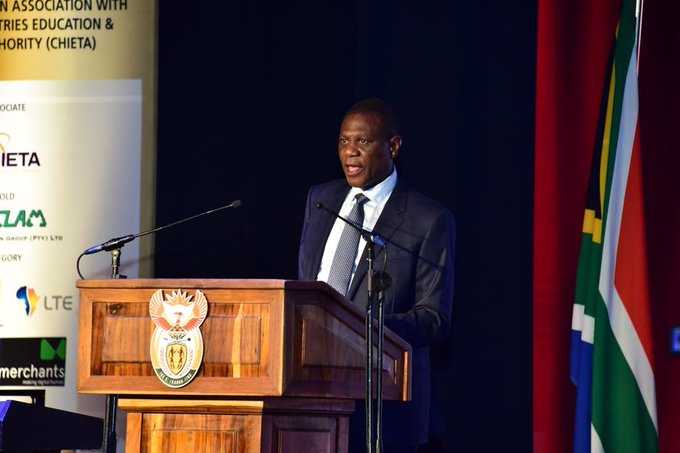
Deputy President Paul Mashatile says government has been working around the clock to help municipalities settle their debt owed to Eskom and water boards.
Mashatile was answering questions in Parliament on Thursday relating to the municipal debt to Eskom and water entities, illegal electricity connections, critical economic infrastructure sabotage, and animal vaccine shortages.
Citing the latest data, Mashatile said by the end of 2022, municipalities owed Eskom R56.3 billion and this debt continues to rise.
“Government has introduced a debt relief package for Eskom intended to improve the utility’s balance sheet whilst proposing that Eskom writes off some of the municipalities’ debts under strict conditions with guidance from National Treasury.“
Mashatile announced that municipal debt relief will be conditional and application-based.
“This relief is aimed at correcting underlying behaviour and operational practices in defaulting municipalities.”
Parallel to this process, the state-owned power utility is introducing a smart metering solution to change consumer behaviour by reinforcing a culture of payment for services rendered.
The Deputy President described the culture of non-payment by municipalities, but also organs of state and individual household customers, as “concerning”.
“As the government, we cannot overemphasise the need to enforce the culture of payment for services rendered.”
National Treasury further developed the Eskom debt relief as a measure to improve Eskom’s financial situation.
He told Members of Parliament that municipalities and water boards are responsible for 65% of the debt to the water trading entities, of which R10.9 billion is overdue by more than three months.
According to the country’s second-in-command, the escalating debt in the water sector is attributed to the absence of economic and regulatory regimes for infrastructure investment, costing and pricing, non-payment of services, and unauthorised connections.
“The government has put in place the measures to strengthen billing and revenue collection to address the escalating debt of municipalities to water entities.”
These include the adoption of credit control and debt recovery measures across all water boards and the installation of bulk-prepaid metres in municipalities.
“The success of all these relief measures is dependent on coordination across all spheres of government. This is why the government will continue working with all sectors of society to increase and build sustainable economic activities in all municipalities to create viable tax bases to develop revenue for social and economic development,” he added.
Mashatile also said government has already addressed 52 of the 67 recommended actions that the Financial Action Task Force (FATF) prescribed when it greylisted South Africa as a country not fully compliant with anti-money laundering measures.
FATF, an intergovernmental body that sets global standards to combat money laundering and terrorist financing, greylisted South Africa in February, based on a 2019 assessment and a report compiled in 2021.
Mashatile said this report identified South Africa “as one of the countries with strategic deficiencies in relation to anti-money laundering and countering the financing of terrorism” and prescribed 67 “recommended actions” that South Africa had to address.
“According to the Financial Action Task Force, South Africa has made significant progress by addressing 52 of the 67 recommended actions,” said Mashatile.
“And we are now, honourable chairperson, focusing on the remaining 15 actions, which we should meet by January 2025. So, that’s the deadline that we have been given to finalise the remaining 15.”