
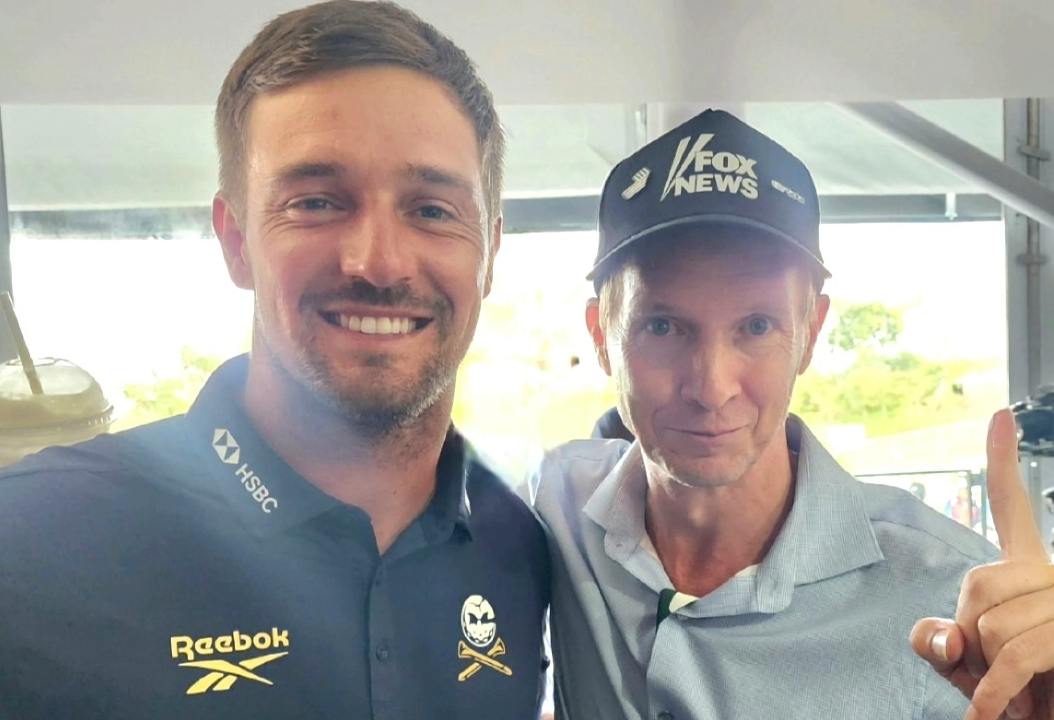
By Kevin Rademeyer, Sports Journalist.
There are golfers you can explain in a sentence. Then there is Bryson James Aldrich DeChambeau, By any conventional measure, he should be simple to define. A powerhouse. An analyst. A two-time major champion. A captain. An entertainer. Yet after a week inside his orbit at LIV Golf South Africa, following him and the Crushers camp from rope line to locker room, clarity never arrived. What emerged instead was something far less comfortable.
A man of sharp edges and soft instincts. Exacting, then erratic. Distant, then disarmingly generous. Entirely human, yet capable of doing things that feel anything but.
DeChambeau has long resisted neat classification. His reputation as “The Scientist” is not marketing fluff. It is method. He builds his game like an equation. Single plane swings. Identical length irons. Air density calculations. Hours spent reducing variables most players accept as fate. He once floated golf balls in Epsom salts to locate their precise centre of gravity. That is not obsession. It is belief.
Then came the transformation. Nearly 40 pounds added. Swing speed pushed to the outer limits. He turned distance into a weapon so blunt it became surgical. When he overpowered Winged Foot to win the 2020 U.S. Open, the message was clear. There was more than one way to dismantle a golf course. And yet, none of that quite prepares you for the man himself.
He arrived in South Africa carrying a win from Singapore and the weight that comes with it. Victory in elite sport is rarely restful. It invites more attention, more obligation, more demand. There was no celebration. No pause. He skipped the opening festivities, choosing instead to retreat to his room and watch Pirates of the Caribbean. Not indifference. Fatigue. A small decision that revealed a larger truth. The week would not be easy.
By Tuesday, the schedule had tightened its grip. Practice. Media. Team duties. Sponsors. Questions asked and answered with patience and clarity. On the surface, everything was functioning. Underneath, something was shifting.
Wednesday stripped away the performance. The Pro Am should have been routine. Controlled. Pleasant. A moment for connection. Instead, it exposed something raw. He waited next to the tee box in a corridor, sitting on the floor, for more than half an hour, detached from everything around him.
Phone in hand. Eyes fixed on the screen. No conversation. No engagement. Not with amateurs, not with other players, not with the media, and barely even with his own caddie, who sat beside him. There was no aura about him, in that moment.
What followed was difficult to watch. He was distracted. Abrupt. At times, openly frustrated. Many would say he was rude. There was swearing after a near collision with a medical cart. A ball struck onto a green while others were still putting. Long silences where there should have been interaction. He was, in truth, unpleasant, and it made the occasion uncomfortable for those who witnessed it. You could not help but ask whether this was the same man so often described as the people’s champion.
For the amateurs, including Louis and Steven Louw this was meant to be a once in a lifetime experience. At times, it felt like an inconvenience to him. It was, plainly, an uneasy display. His team did not ignore it. They acknowledged it quietly. They spoke of fatigue. Of travel. Of frustration with his swing. Of issues beyond golf. “He’s human,” one said. Not as an excuse, but as context.
At the end of the round, he apologised directly. No theatrics. No deflection. He offered putting advice to another player who approached him. A small attempt to repair what had been a fractured few hours. To their credit, the amateur players still described the day as unforgettable. Enjoyable, even. I did not share that view, though I was glad they found value in the experience.
There is a saying that you should not meet your heroes. That afternoon gave it weight. And yet, that is not the full story. Not even close. Because outside the ropes, a different version of DeChambeau emerged.
On tournament days, he gave his time freely. Twenty-seven minutes signing autographs after the first round. More than an hour on the final day. No rush. No visible irritation. With children, he was patient. With fans, he was present. With the media, thoughtful and precise. “This gives me energy,” he said. “It motivates me to perform.” There was no trace of the detachment seen earlier in the week.
As the tournament unfolded, it became clear this was not just about golf. “Life is not easy sometimes,” he admitted. “There’s a lot going on.” He did not elaborate. He did not need to. Golf, in that moment, felt less like a profession and more like a refuge. A place to channel noise into something measurable. Something controllable. Faith, family, and fleeting human moments steadied him.
One of those moments came on the 16th hole on Sunday. A brief exchange with a fan brought him to tears as rain began to fall and thunder rolled in. The course changed. Conditions deteriorated. The margin for error disappeared. He was emotional, but the kindness of a fan and the memory of his late father carried him forward.
What followed was the most honest version of DeChambeau you will see. Not in words, but in action. This is where champions separate themselves. Over the closing stretch and into a playoff, he held his nerve as the weather turned chaotic. Mud. Rain. Reduced visibility. Decisions that had to be made instantly and lived with forever.
Where others hesitated, he committed. “I was just praying all day,” he said later. “Praying to give me the perseverance to move forward.” Then came the shot. A towering three wood from 295 yards in a playoff. Struck cleanly. Timed perfectly. Executed under pressure that would undo most players. It was not just skill. It was clarity.
It was, quite simply, the greatest golf shot I have ever witnessed, played in brutal conditions under immense pressure. And it forced an uncomfortable question. How could the same man who seemed so disconnected days earlier produce something so precise, so extraordinary?
The emotion arrived at the end. On the 18th green. In the press conference. It was unrestrained. “Just grateful. It’s been a tough few weeks. It’s not always sunshine and rainbows,” he said. “Having these people around me helped me persevere… I’m super emotional.”
Then more, and heavier. “When you have moments in life that aren’t easy… don’t ever quit. There was a moment on 16… something a fan did made me cry… there’s more to life than just golf.”
He paused. Struggled. Continued. “Losing my dad wasn’t easy. Going through what I’m going through isn’t easy… there’s just a lot going on. “There was nothing rehearsed in it. No polish. Just truth, delivered in fragments.
Sport has a habit of simplifying people, packaging them into something easy to understand. DeChambeau resists that instinct. He can be abrasive. He can be distant. At times, he is difficult to watch. He is also generous with his time, fiercely loyal to his team, and capable of extraordinary resilience when it matters most.
Most importantly, he is human. Entirely so. And yet, in the moments that define outcomes, he accesses something rare. The ability to isolate the present, remove the noise, and execute with ruthless precision. That is not normal. That is the difference.
A week in South Africa did not clarify Bryson DeChambeau. It deepened the mystery. And then, just when it seemed the story had settled, it shifted again. After the trophy ceremony, more than 15 000 voices echoed his name in front of the main stage. A chorus reserved for those who deliver when it matters most. Minutes later, inside the quieter space of the media room, the noise disappeared.
He saw me at the door. No hesitation. No performance. No cameras. He stepped forward, embraced me, and thanked me for the support. His team did the same. It was unprompted. Unfiltered. Entirely genuine. This was not the same man from Wednesday. Not even close.
This was the full picture. A man who works relentlessly. Who thinks differently and accepts the cost of that difference. An outlier who has reshaped the game. Someone who detests losing, who can overthink, who can let frustration surface. Complicated, yes. Temperamental at times. But also a man of integrity. Of resilience. Of patience and perspective earned the hard way.
You do not achieve what he has by being ordinary. You do not carry what he carries and remain untouched. In the span of two weeks, he has crossed continents, earned more than R150 million, been lifted by crowds, and quietly wrestled with burdens few can see. And still, when the moment demands it, he shows up.
That is what endures. Not the contradictions, but the response to them. Not the noise, but the ability to rise above it. He remains, unequivocally, a champion, and a hero to many. He made me emotional watching him and made me respect the game of golf even more. I love that he is human, however he can do extraordinary things. The world needs people like that.