
By Kevin Rademeyer, Sports Journalist.
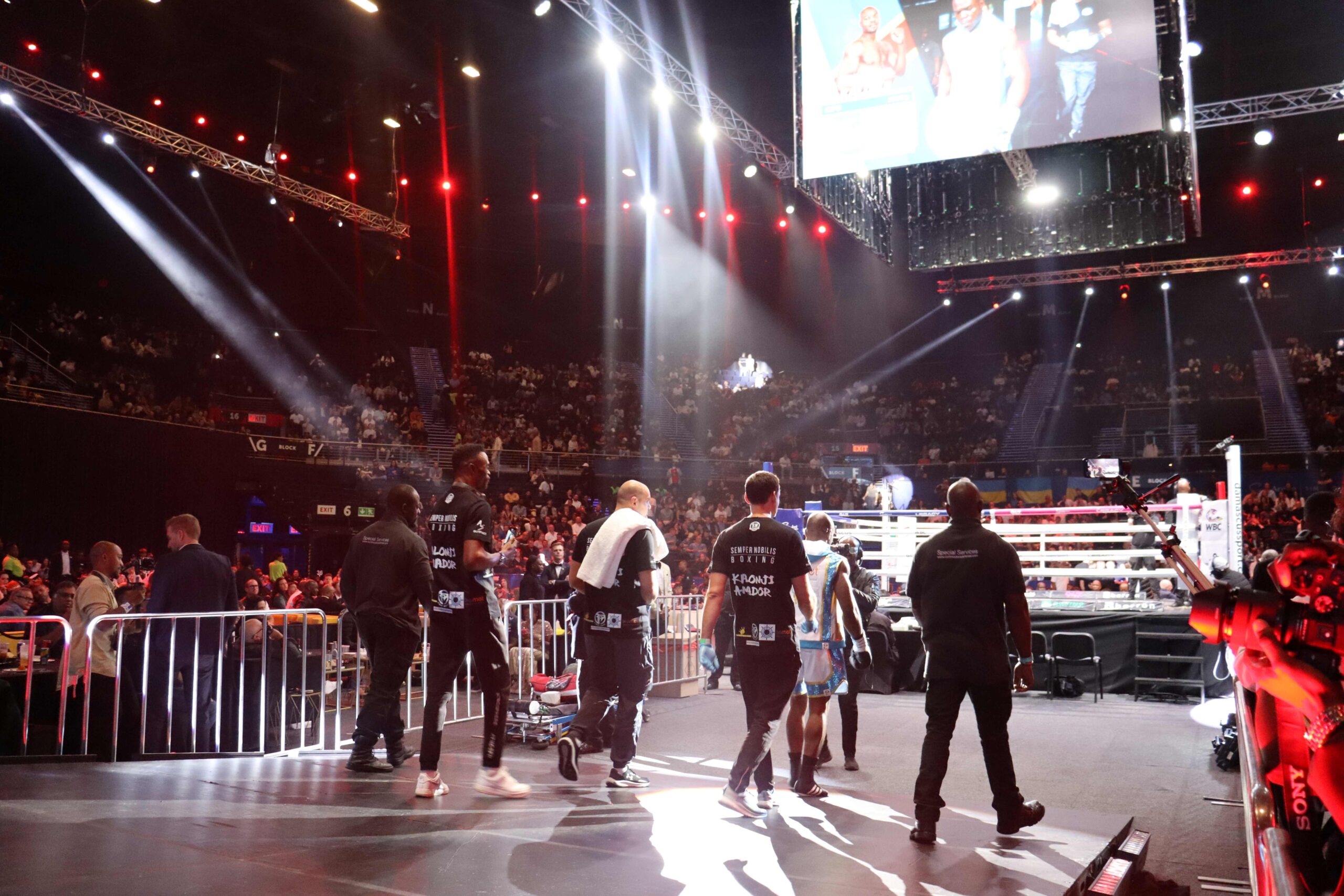
By any conventional measure, Saturday night’s Knockout Chaos card in Sandton may seem like a modest promotion. Eight bouts. A mix of prospects, journeymen, and a handful of recognisable domestic names. No world titles on the line. No pay per view glare. No stadium. Yet to judge it solely on those terms is to miss something essential about both the moment and the machinery of boxing.
Because when the fighters step through the ropes at the Galleria Events Venue on 25 April, the real story will not be confined to the ring. It will unfold in the spaces between ambition and opportunity, in the quiet calculations that sustain the sport in South Africa, and in the presence of a fighter who will not be there yet remains central to it all.
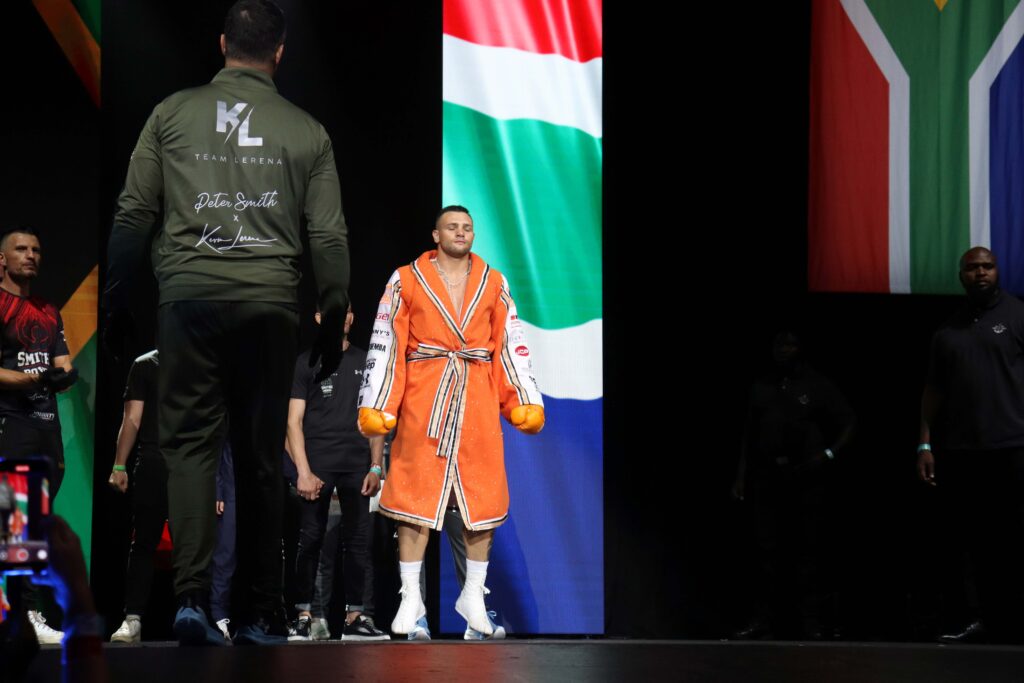
Aquila Boxing Promotions will spend the next few days building more than a fight card. Press conferences, face-offs, weigh in, each moment carefully arranged. Not merely to inform, but to suggest meaning. Boxing has always depended on that delicate illusion, the sense that something significant is about to happen, even when the evidence is still taking shape.
Whether Saturday night fulfils that promise remains uncertain. At the top of the bill, heavyweight Keaton Gomes meets Youssouf Mwanza over six rounds. It is not a fight that will echo across continents, but within its own ecosystem it carries huge weight. Heavyweights always do. There is something elemental about them, something that draws attention regardless of context.
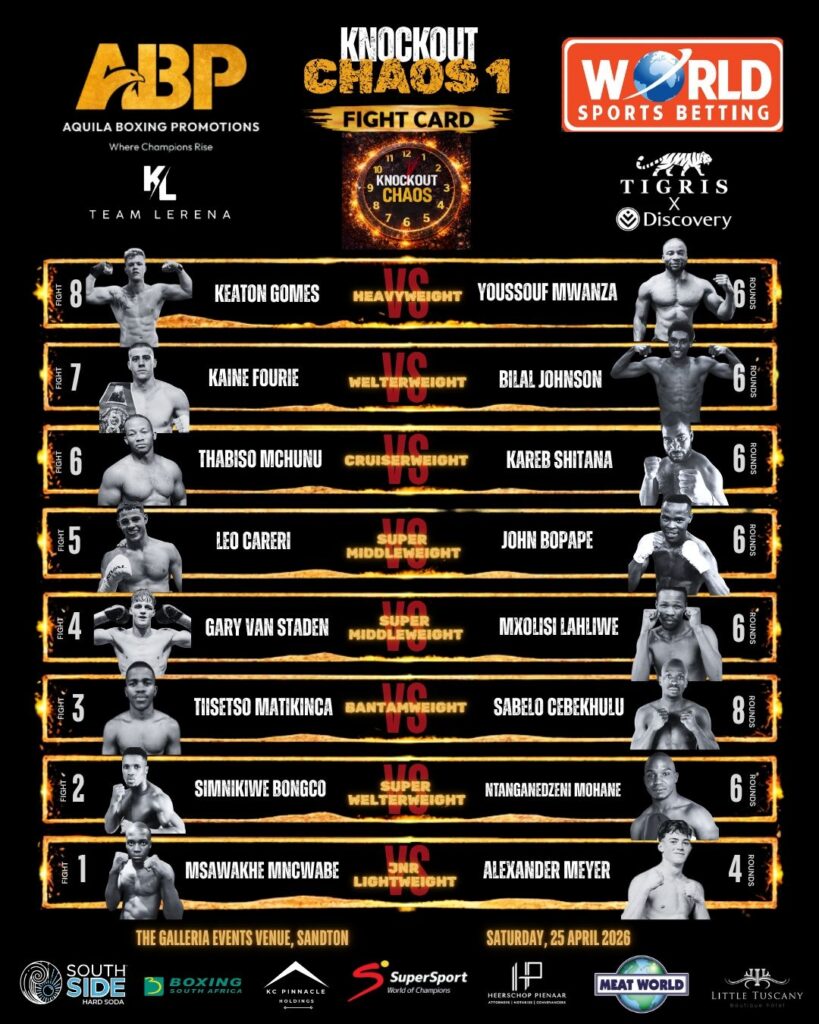
Elsewhere, Thabiso Mchunu returns to a stage that feels smaller than the one he once occupied, facing Kareb Shitana. Mchunu’s presence lends the evening credibility, a reminder of a time when South African fighters moved more freely across borders, when their ambitions travelled further and with greater consequence.
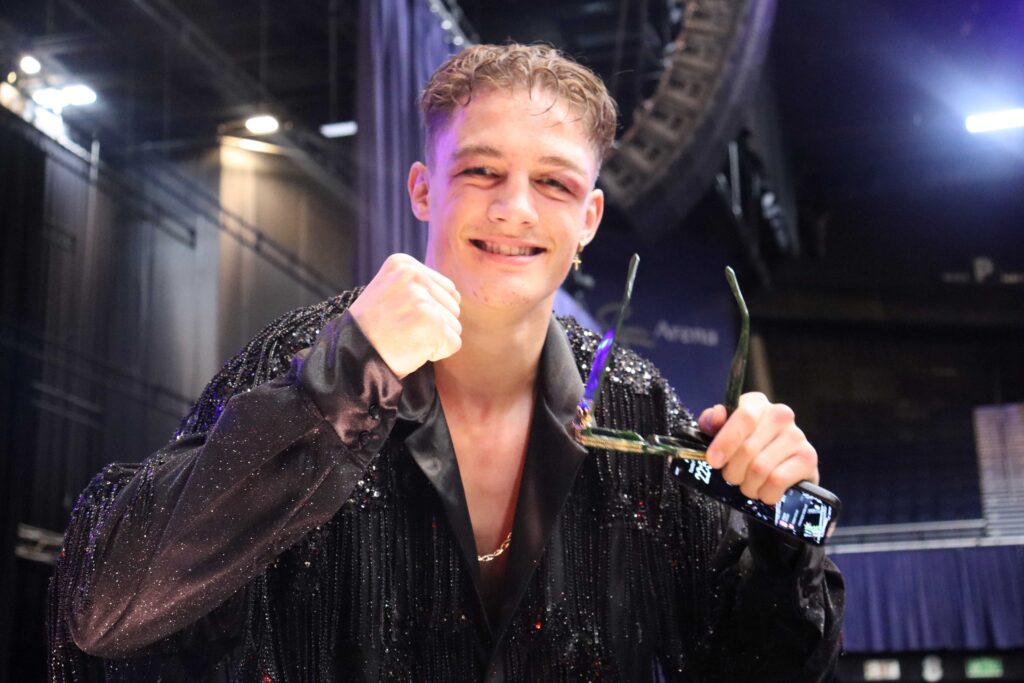
The rest of the card follows a familiar rhythm. Competitive pairings rather than careful mismatches. Fighters such as Kaine Fourie, Bilal Johnson, Tiisetso Matikinca, and Sabelo Cebekhulu inhabit that uncertain middle ground. Not yet global stars, not simply opponents, waiting as so many do for something to shift in their favour. There is also a sense of emergence, with figures like Leo Careri and Gary Van Staden carrying the quiet suggestion of future possibility, their presence adding energy and flamboyance to a night that promises urgency from the opening bell to the last.
And then there is Kevin Lerena. Not in the ring, but everywhere else. The face of Aquilla Promotions. The man that is helping put it all together. His absence within the ring is noted, precisely because of what he represents. In a landscape often defined by limitation, Lerena has carved out something broader. Recognition beyond South Africa’s borders. A world title. A career that extends beyond a single evening’s work. He is a fighter who has come close enough to greatness to understand both its allure and its cost.
He will get his chance to shine next month. On 30 May, in Charleroi, Belgium, he will defend his WBC bridgerweight title against Ryad Merhy. It is a rematch shaped as much by necessity as by legacy. Lerena won their first meeting on points in 2023. This time, he speaks in different terms. He does not want a decision. He wants a finish.
“I must knock him out in his home country,” he has said. It is a declaration that carries both confidence and pressure. Because his career has settled into a place of tension, between divisions, between expectations, between what has been achieved and what still feels just out of reach.
The bridgerweight division itself reflects that uncertainty. Created as a space between cruiserweight and heavyweight, it offers opportunity without complete validation. Some recognise it. Others remain unconvinced. For Lerena, it is both platform and compromise, a place where he can hold a title while still searching for something more definitive.
At cruiserweight, the weight cut has grown unforgiving. At heavyweight, the risks multiply. Victories over Bogdan Dinu and Mariusz Wach hinted at promise, but defeats to Daniel Dubois and Lawrence Okolie imposed harsher truths. A narrow loss to Justis Huni reinforced the point. At that level, ability and heart alone ,is not always enough.
So bridgerweight becomes the middle path. A place to remain visible. To build leverage. To stay in contention. Yet even there, certainty is elusive. Merhy arrives with his own resilience, shaped by defeat and recovery, by movement between divisions and the persistence required to return to relevance.
This rematch is not about closure. It is about definition. Lerena understands that. Winning may not be sufficient. He must be convincing. He must leave no doubt. “I want to stop him,” he has said. “Then get on another big card.” It is the language of a fighter who understands that in boxing, performance and opportunity are inseparable.
Away from the ring, Lerena has offered a different version of himself. He has become the “People’s Champion” by motivating schoolchildren and young boxers. He gives back by reflecting on failure, on discipline, on the uneven road that defines both sport and life. “Be humble, but always be hungry,” he tells them. It is a familiar phrase, but in boxing it carries a certain gravity. The sport has a way of exposing anything less.
He has spoken of setbacks, of fighting through personal strain, of learning that success rarely follows a straight line. None of it was new. All of it mattered. And in those moments, the connection to Saturday night becomes clearer.
Because the fighters stepping into the ring in Sandton are navigating the same terrain, just at a different stage. Most will never reach the level Lerena occupies. Some will not move beyond this point. A few might. But all are part of the same system, one that demands constant motion, constant work, constant belief.
Promotions like Knockout Chaos are not simply about entertainment. They are about survival. About sustaining a sport that depends on opportunity as much as talent. They provide rounds, exposure, a chance however small, to move forward.
For Aquila Boxing Promotions, Saturday represents intent, the beginning of a year they hope will carry momentum. For the fighters, it is more immediate. Another night. Another risk. Another step, however uncertain, towards something greater.
For Lerena, watching ringside, it is a reminder of where he has been and what still lies ahead. Because in boxing, there is no clear divide between levels, only varying degrees of visibility.
On Saturday night in Sandton, the lights will burn bright for those inside the ropes. On 30 May in Belgium, they will shine brighter still. What connects the two is not scale, but uncertainty, and the understanding that in this sport, every fight is both a conclusion and a beginning.