
By Lehlohonolo Lehana.
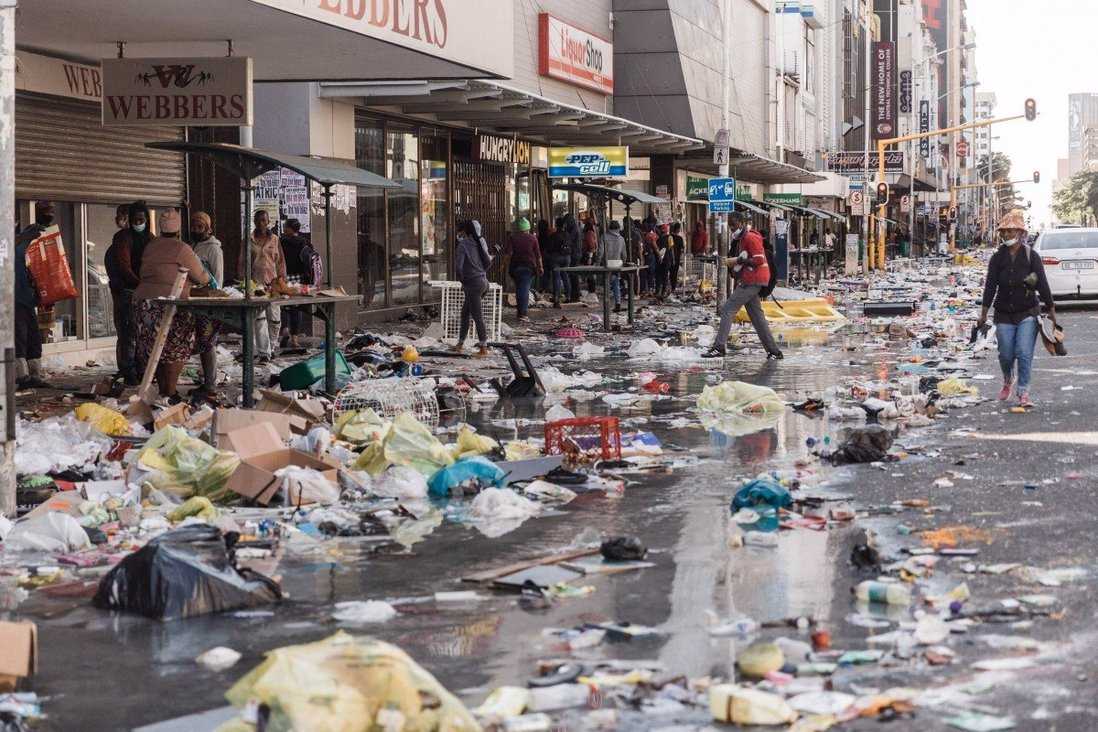
The SAHRC and the Commission for the Promotion and Protection of the Rights of Cultural, Religious and Linguistic Communities (CRL) on Monday released their reports into the July 2021 unrest.
The commission’s report had found that July unrest in 2021 was an orchestrated event which required that individuals act with one voice to achieve its end.
The Commission’s work focused on four issues namely:
- The social, economic, spatial, and political factors prevalent in the various affected areas, and the extent to which these played a role in the unrest.
- The causes of the alleged racially motivated attacks and killings in the country.
- The causes of the apparent lapses in law enforcement by State Security agencies, particularly in the South African Police Service, and the role of private security companies in the unrest.
- The causes of the July unrest, with particular focus on Gauteng and KwaZulu-Natal.
SAHRC chairperson Chris Nissen said after the events happened in KwaZulu-Natal and Gauteng, the commission sat down to discuss how this could be prevented in the future.
He said they had to investigate and find out more about the impact it had on human rights.
The commission conducted public hearings in the two provinces.
In the report, the commission found that damage to the economy was R50 billion and more than 350 people were killed.
“The evidence presented to the commission shows that acts which occurred during the unrest were indeed orchestrated,” the report found.
“The blocking of the N3 and the N2, the calculated destruction of factories and warehouses, the organised disconnection of security and fire alarm systems, the attack on government communication facilities at the Durban Port, and the bombing and removal of ATM’s – together, cannot be viewed as mutually distinct. These events point to a significant investment in the execution of the July unrest,” it read.
“The evidence further points to two types of actors in and during the July unrest. Primary actors who were well resourced, led and executed the widespread destruction of property, and perpetrated arson attacks. They in turn mobilised secondary actors, who participated in acts of theft at malls and other business premises.”
The report found that the police were ill-prepared for what happened. The police came under fire from other reports for failing to act during the July events.
The SAHRC also found that the jailing of former president Jacob Zuma could not be directly linked to the looting and violence in KZN and Gauteng provinces.
Zuma was sentenced to 15 months in prison by the Constitutional Court for refusing to appear before the State Capture Commission of Inquiry into State Capture.
The apex court found that Zuma was in contempt of the court.
The SAHRC report said while many people drew inferences that the incarceration of Zuma was linked to the July unrest, it could not find any evidence of this.
“However, the commission finds that while the timing of the events of the July unrest coincided with the incarceration of Zuma, it could not find evidence to link the two events.”
The report has recommended that socio-economic factors must be addressed in the country to prevent similar incidents in future.
In conclusion, the SAHRC found that the July unrest was “a violent culmination of deep rooted political and economic discourse”.
“While evidence pointed to high-level orchestration, the common purpose or intention behind the Unrest remained unclear. The violence and destruction were symptomatic of unresolved systemic conditions, including post-Covid-19 economic recovery, high unemployment, lawlessness, discrimination, socioeconomic divides, and issues within the security sector.
“The commission concluded that organised groups and individuals opportunistically exploited these conditions to attempt to usurp the rule of law.”
The Commission for the Promotion and Protection of the Rights of Cultural, Religious and Linguistic Communities chairperson, Luka Mosoma found that racism is prevalent in Phoenix, and it has a negative impact on the lives of the African people in terms of economy, public service, etc.
“An inherent systematic prejudice exists, and it continues to marginalise the African people. This provides a collective power of one group over the other.
“Racism is allegedly pervasively present in Phoenix and surrounding areas, and it has been brought to the attention of the CRL Rights Commission and at how it affects the communities”.
Mosoma urged the government to build a statue as a remembrance of those who lost their lives during the 2021 July unrest.
“In the African culture, cleansing is a necessary ritual to appease, acknowledge and recognise those who have gone before. Therefore, cleansing and healing are the restoration of the relationship between the living and the dead.
“For this reason, we recommend a collective cleansing encompassing multi-cultural and multi-religious communities. The CRL shall be the facilitator of this process.”
The full report can be obtained at https://www.sahrc.org.za/home/21/files/JULY%20UNREST%20REPORT%20FINAL_29%20JAN%202024.pdf.