
By Lehlohonolo Lehana.
The Inter-Ministerial Committee (IMC) on Migration has reaffirmed the government’s commitment to managing migration in an orderly manner following the Constitutional Court’s judgment on asylum seekers applications.
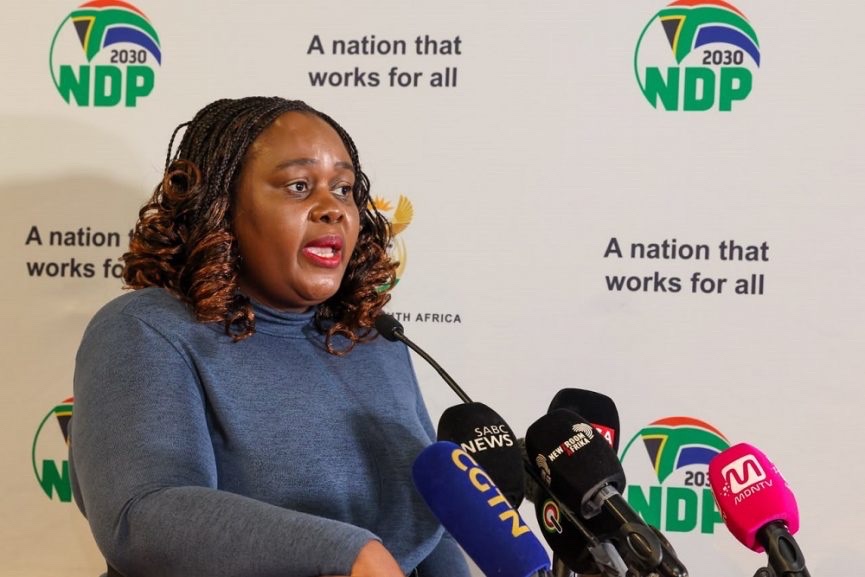
Addressing a media briefing in Pretoria on Thursday, the IMC said the Constitutional Court judgment, handed down in July 2026 in the matter of Scalabrini Centre of Cape Town and Another v Minister of Home Affairs and Others, must not be interpreted as legalising unlawful migration or giving people an automatic right to remain in the country.
The Court declared certain provisions of the Refugees Act unconstitutional because they prevented some people from accessing the asylum system solely on procedural grounds. These included people, who had entered South Africa irregularly, did not possess an asylum transit visa or failed to report to a Refugee Reception Office within the prescribed period.
The Court found that such procedural barriers could result in people being excluded from the asylum process before their claims were properly assessed.
The IMC said the judgment, therefore, restores access to the asylum determination process, rather than automatically conferring refugee status.
“Importantly, the judgment does not grant refugee status or permanent residence automatically to anyone who enters South Africa, nor does it legalise unlawful migration.
“It simply requires that individuals claiming asylum be allowed access to the asylum determination process so that their claims can be properly assessed in terms of the law,” IMC Chairperson, Justice and Constitutional Development Minister Mmamoloko Kubayi, said while delivering the statement.
The IMC stressed that applicants must still undergo the formal Refugee Status Determination Process and meet the requirements of South African law.
“Applications that are fraudulent, abusive, unfounded or do not meet the requirements of the Refugees Act will still be rejected through the established legal processes,” Kubayi said.
The IMC said the Constitutional Court’s decision should be understood as a correction of a procedural barrier, rather than an expansion of the substantive requirements for obtaining refugee status.
“The court’s decision only remedies a procedural defect regarding how applications are initially processed,” the IMC said.
This means that a person cannot be prevented from accessing the asylum process solely because of issues such as the absence of a transit visa or failure to meet a prescribed reporting deadline.
However, once an application is accepted into the system, the applicant must still have their claim assessed.
“The ruling does not grant automatic refugee status or guarantee a right to remain in South Africa indefinitely.
“Every applicant must still subject themselves to the formal Refugee Status Determination Process, where their claims will be thoroughly investigated under the strict criteria set out in international and domestic law,” Kubayi explained.
The IMC said government also retains its authority to enforce immigration legislation.
“Government retains its full sovereign right and duty to enforce the Immigration Act, “Kubayi said.
People who are found not to qualify for refugee protection or who abuse the asylum system can still face lawful deportation once the applicable legal processes have been completed.
The committee said the judgment reaffirmed South Africa’s constitutional and international obligations, particularly the principle of non-refoulement.
The principle prevents the return of a person to a country where they may face persecution, conflict or serious harm.
The IMC said this obligation must be balanced with the State’s responsibility to manage its borders and migration system, in accordance with the law.
Government, therefore, remains bound to ensure that asylum claims are properly assessed before a person, who may genuinely require international protection, is returned.
Minister in the Presidency Khumbudzo Ntshavheni said the spread of misinformation in this matter stems from a misunderstanding of directives, issued by the Department of Home Affairs to Refugee Reception Offices, as it pertains to implementing the Constitutional Court judgment.
She said government will review the directives to ensure there is no further confusion.
“[Another] allegation is that there are people who are using broadcasting platforms to spread misinformation,” she said, adding that complaints about broadcasters or presenters allegedly spreading misinformation could be lodged through the Broadcasting Complaints Commission of South Africa (BCCSA).
She also reminded the public that the public broadcaster is not a State institution and therefore operates independently of government.
Ntshavheni said an important part of the misinformation surrounding the asylum issue is the suggestion that the current situation results from a government decision.
She said the Constitutional Court is the apex court in the judiciary and that its decisions must be respected.
Ntshavheni said government, nevertheless, has a responsibility to protect the interests of South Africans, while complying with the Constitution and the country’s legal obligations.
She said the IMC has recognised the unintended consequences arising from the judgment and is obtaining legal advice on the options available to government.
“We have met and we continue to meet to process this issue so that we are guided by the law because, as the Chairperson [of the IMC, Minister Kubayi] has said in the statement, the Constitution of the country is supreme and therefore, we need to be guided,” the Ntshavheni said.