
By Lehlohonolo Lehana.
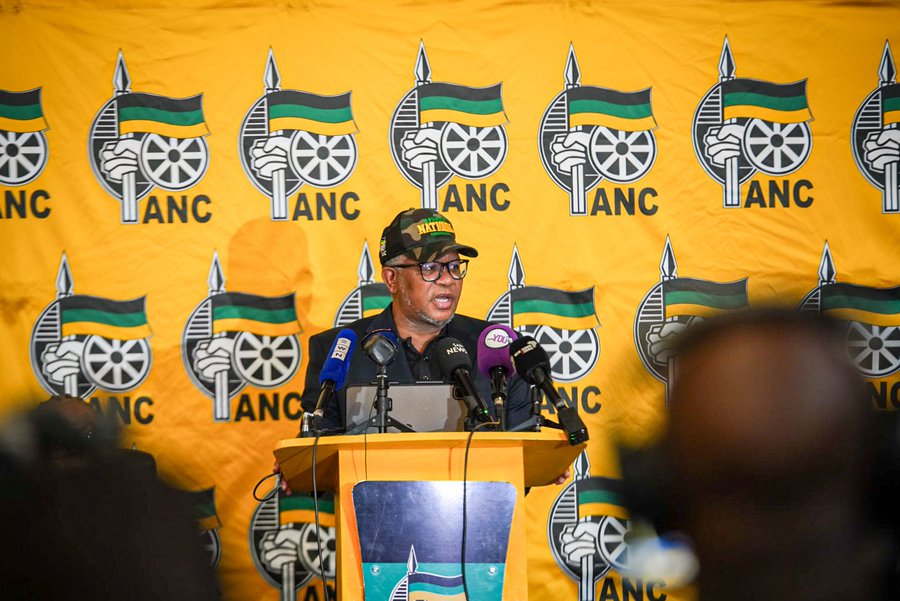
The African National Congress (ANC) secretary general Fikile Mbalula says the upcoming “People’s March” is a reaffirmation of the “true values” of the country’s democracy, a rejection of division and misinformation, and a call for unity.
Mbalula briefed the media at Luthuli House in Johannesburg.
The mobilisation will be led by the ANC and its alliance partners, the South African Communist Party, Congress of South African Trade Unions and South African National Civic Organisation, and will bring together business formations, labour, faith-based organisations and civil society movements.
This mass mobilisation coincides with Human Rights Day and marks 30 years of the South African Constitution.
Mbalula described the event as a necessary response to the rise of misinformation, distortion and coordinated narratives, which he said sought to undermine public confidence in democratic institutions, and create division among the country’s people.
He said these narratives were often driven by narrow interests that were opposed to transformation and that sought to preserve historical privilege.
Mbalula added that there were broader global dynamics and external pressures intersecting with these domestic challenges, that sometimes, reinforced instability and uncertainty.
He said South Africa approached these uncertainties with sobriety and responsibility.
“We will not be reckless, nor be drawn into unnecessary confrontation, instead we remain guarded by the principles of democratic engagement, constructive dialogue and the defence of national sovereignty, within the framework of international cooperation,” he stated.
He said on Saturday citizens would not rise in disorder but in disciplined formation.
Meanwhile the first deputy secretary-general Nomvula Mokonyane said the party will not meet with US ambassador to South Africa Leo Brent Bozell until he is formally welcomed to the country by President Cyril Ramaphosa.
Bozell has been meeting with various stakeholders, including political parties in Pretoria, as part of his efforts to understand the South African landscape. This comes amid tensions between Pretoria and Washington over various issues including South Africa’s transformation policies.
“Up until the time the president receives his credentials he is not an ambassador based in the Republic of South Africa so we are awaiting that because we understand processes. Others can meet with him others can interact with him but up until the head of state who has to receive him accepts his credentials we are not even looking forward to an invitation because it will be informal and it will not add value,” she said.
Mokonyane confirmed that the ANC had received an invitation from Bozell’s office.
“We do note of course that there are many that have met him but understanding the diplomatic space we believe that this is the right approach,” she said.
Bozell, 70, was a controversial choice for ambassador, having opposed efforts by the ANC – the biggest political party in the coalition government led by President Cyril Ramaphosa – to overturn apartheid in the 1980s.