
By Lehlohonolo Lehana.
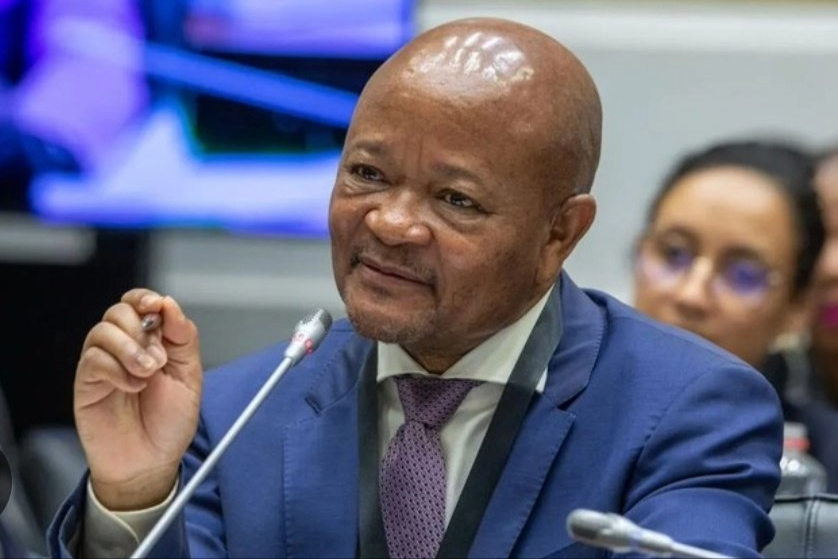
After 54 days since the first sitting of the Judicial Commission of Inquiry into Criminality, Political Interference and Corruption in the Criminal Justice System (the Madlanga Commission of Inquiry), iced Police Minister Senzo Mchunu re-appeared this afternoon.
A rising star in the ANC, he was felled by accusations of falling for influence-mongering by political fixers linked to criminal networks.
On 6 July 2025, his life changed when KwaZulu-Natal police commissioner Nhlanhla Mkhwanazi, dressed in camo, surrounded by Special Task Force members with their faces hidden by balaclavas, made bombshell allegations.
He alleged that Mchunu had disbanded the police’s Political Killings Task Team (PKTT) for spurious reasons. Mkhwanazi said that Mchunu was acting as a proxy for Burberry-loving alleged murderer, tenderpreneur and convicted criminal Vusimuzi “Cat” Matlala.
Matlala had fallen into the crosshairs of the PKTT, which expanded out of KZN and into Gauteng where its members had pieced together a conspiracy linking Matlala with another crime boss.
The other crime boss is Katiso Molefe, allegedly the hitman behind a series of assassinations of DJs and allegedly of Transnet supplier Armand Swart.
Mchunu was perceived to be a reformist in the ANC and was closely aligned with President Cyril Ramaphosa, who promoted him from the Water and Sanitation portfolio to the crack job of Police Minister in the Government of National Unity (GNU).
Mchunu was relentlessly cross-examined on his second day at the commission, as Commission Chair Mbuyiseli Madlanga systematically poked holes in his version that there was nothing improper about his decision to disband the PKTT.
Madlanga noted that Mchunu issued his directive without consulting a single senior SAPS leader, despite Mchunu saying he and police commissioner Fannie Masemola had a good relationship.
Mchunu said there had been meetings on 1 November and 22 December with the police to review the NKPTT, but its potential disbandment was not discussed.
Madlanga found it perplexing that throughout the lifespan of the PKTT — during multiple interministerial committee meetings — the unit was consistently praised for its work. Mchunu justified the disbandment on the basis that the PKTT was never meant to be a permanent structure. But the document he relied on was years old.
While he had acted independently, Mchunu said he also consulted his special adviser.
“As I wrote that directive, I was within the constitution and legislative framework, but I did consult special adviser advocate Vusi Pikoli, who then indicated comfort in terms of the exercise of that responsibility.”
He said he consulted Pikoli on the day he issued the directive, but this followed earlier discussions about the scope of the police minister’s powers.
He said a range of complaints prompted his action.
“The complaints from various complainants varied in content and emphasis, but they shared common themes, namely unmonitored task team operation resulting in grave human rights abuses,” Mchunu said.
There were “unclear reporting lines in terms of who these task teams report to and allegations of overreach, duplication of functions and significant strain on SAPS resources”, he said.
Complaints came from “people who knew one or two things about police and who felt a concern of one kind or another about policing in the country”. They also included human resources (HR) allegations “alleging some internal abuses within police and some within [the political killings task team] and instances of criminality”.
Mchunu testified that Lieutenant General Samson Sihlabane had complained about the task team, which the Deputy Police Minister Cassel Mathale, resolved on his instruction.
He referred to an internal SAPS report recommending that task teams undergo an impact analysis to assess feasibility. He also said a 2020 SAPS structure “clearly indicates that the murder and robbery did exist as a section”.
He insisted there had long been an intention within SAPS “to build murder and robbery” and he had personally made efforts to “intensify understanding” of the institution.
The minister of police has no operational role within the task team, “and there was no civilian and ministerial control over its function, which resulted in grave abuse of human rights”, Mchunu added.
He said it was irrational to prioritise one category of killings over South Africa’s broader murder crisis.
“I don’t think that it is fair to devote substantial resources to one category of killings in the country, which is politically related killings and not any other killings, when the evidence is that there is an urgent need to focus on all murders.”
He told the commission he had been deeply concerned by high murder levels since taking office, and his administration identified four priority crimes: murders, the proliferation of firearms, drugs, as well as gender-based violence and femicide.
These crimes “dictate to your conscience a need, almost exclusively, to attend to those”, he said, adding that they characterised South Africa’s criminal landscape.
Political killings must be seen within the broader crime context, he said, adding: “And therefore we can’t keep on focusing on just one category, which in my view, is small, compared to the other, as statistics will indicate. A central consideration that informed my approach was the need to strengthen SAPS’ permanent structures rather than continue to rely on a temporal project.”
But Madlanga was unconvinced. He pointed out that Mchunu’s justification would only make sense if he had actually consulted SAPS management — and if they had expressed these views before he took the decision on 31 December 2024. Since no such consultation took place, the minister’s explanation simply did not hold.
The commission is concluding its public hearings for 2025 by tomorrow (Friday), 5 December and will deliver the interim report to President Cyril Ramaphosa by 17 December, which is the revised deadline as set out in the amended Terms of Reference.