
By Mmangaliso Khumalo.
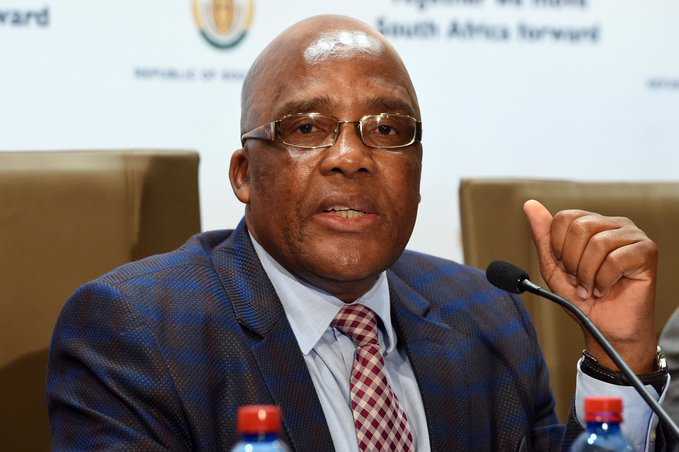
Health Minister Aaron Motsoaledi has delivered a blistering response to the findings of Health Ombud Professor Taole Mokoena, who on Wednesday released a damning report into the deaths of Dr Edward Mabubula and Pitsi Eliphuz Ramphele.
The Ombud described the deaths as “avoidable, preventable and deeply disturbing”.
Speaking at the release of the 118-page report, Motsoaledi said the failures documented at the Wits Donald Gordon Medical Centre and Pietersburg Provincial Tertiary Hospital reflect a collapse in basic clinical ethics, supervision, and patient care, and demanded harsh consequence management for those responsible.
‘No excuse for what happened’
Motsoaledi said the clinical errors and oversight failures at both institutions extend far beyond equipment shortages or heavy workloads.
He described some of the conduct recorded in the report — including staff leaving shifts without attending to critically ill patients, missed diagnoses, and the falsification of medical records — as “unforgivable”.
“There is absolutely no excuse for what has happened here. Even stopping the issues of management, just the clinical care — I have never seen senior doctors behave like this. And a nurse who falsifies records is a criminal, and must be treated as such.”
Two deaths, same pattern of systemic failure
Professor Mokoena’s report found that although the two patients died in different settings — one private, one public — the underlying failures were strikingly similar.
In the case of Dr Edward Mabubula, admitted to Donald Gordon Medical Centre in March 2021, the Ombud found that clinicians ignored clear signs of deterioration, delayed critical tests, and failed to escalate his care to senior specialists.
Junior staff reportedly worked in silos, nursing notes were incomplete, and families were left confused about who was in charge.
At Pietersburg Tertiary Hospital, Pitsi Eliphuz Ramphele, a 54-year-old father, died after prolonged waits, a lack of monitoring, and poor handovers between shifts.
Incoming staff often “had little idea” of his condition, and the Ombud concluded that the deterioration in his health “was entirely predictable”.
“These two deaths happened in very different institutions, but the nature of the failures is alarmingly similar. In both cases, the safeguards that are supposed to protect patients were simply not functioning,” Mokoena said.
Motsoaledi said the findings at Pietersburg Hospital reveal a catastrophic breakdown in the entire chain of care.
“If these two facilities were a human being, I would diagnose them as suffering from multi-system organ failure, because almost everything went wrong. And this cannot be forgiven by any standards.”
The minister added that clinicians walking out before attending to patients, and failing to intervene when records showed severe risk, “cannot be explained by staffing shortages”.
Minister challenges Ombud: ‘Corrective action is not enough’
Although praising Professor Mokoena’s extensive work, Motsoaledi publicly disagreed with the Ombud’s sentiment that the report is primarily corrective rather than punitive.
“What happened in Polokwane requires very serious punitive measures so that people know you cannot play games with human life. Every life is precious.”
He urged the Health Professions Council of South Africa (HPCSA) and the South African Nursing Council to pursue disciplinary action against clinicians involved in both cases, calling their conduct ‘a betrayal of medical ethics’.
Government given 30 days to act
The Ombud’s report recommended referrals to professional councils for possible misconduct, mandatory escalation and emergency care training, strengthened monitoring and handover systems, revised clinical governance structures, and swift internal disciplinary action where administrators fail in their duties.
The Department of Health now has 30 days to respond formally with an implementation plan.
Motsoaledi said the deaths of Dr Mabubula and Mr Ramphele must be a turning point for the country’s health system.
“These cases must spur meaningful reform. We cannot allow preventable deaths to become normalised in our hospitals.”