
By Lehlohonolo Lehana.
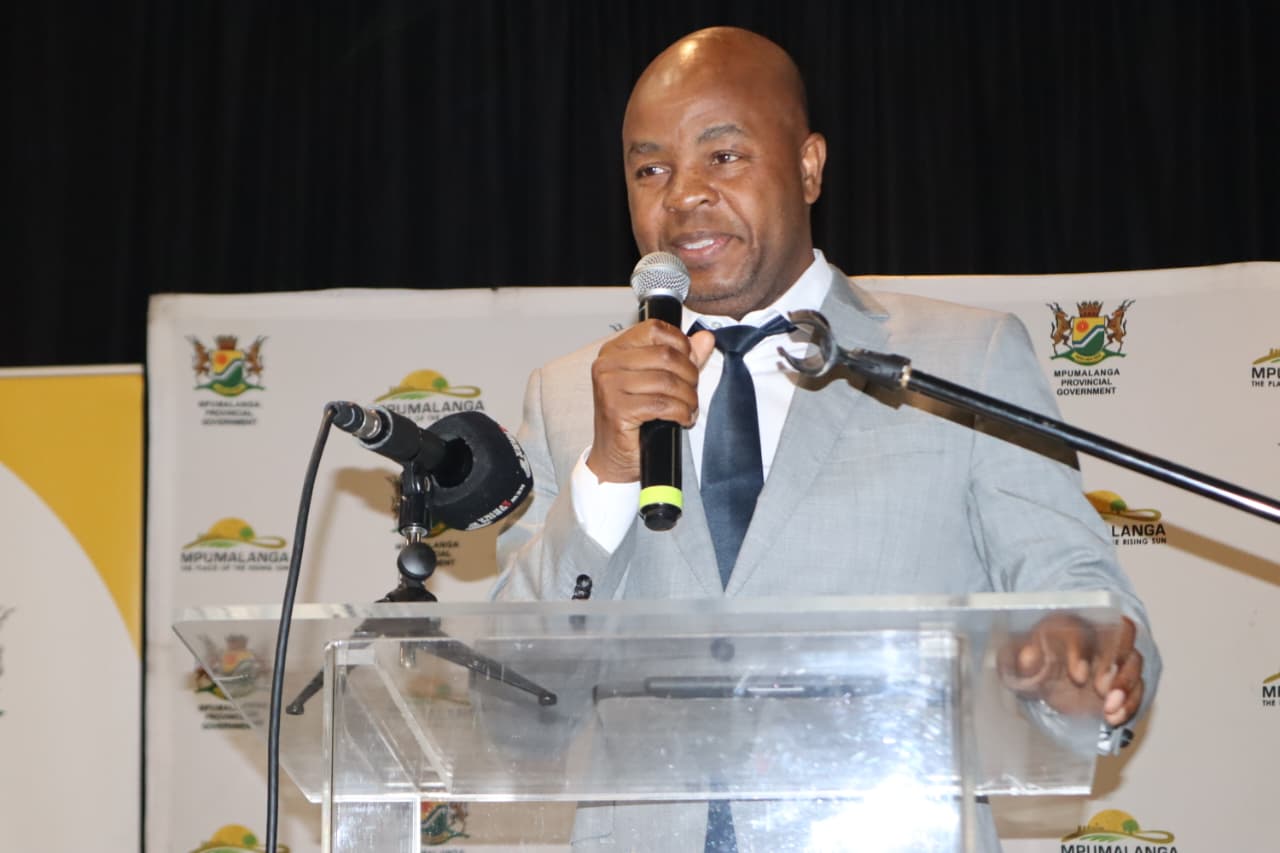
Mpumalanga premier Mandla Ndlovu delivered the State of the Province (SOPA) at the Legislature, where he outlined amongst others, the targeted interventions to address socio-economic and service delivery challenges.
Ndlovu stressed the importance of collaboration between government, industry and civil society in addressing structural economic challenges.
He made the point that solving problems including unemployment, poverty and inequality required a collaborative, all-hands-on-deck approach by government, the private sector, labour and civil society.
Noting Seriti Green’s alignment with provincial priorities, he highlighted the company’s structured entrepreneur programmes that were designed to catalyse sustainable job creation and broaden economic participation.
Seriti’s Agri for Change programme, which supports emerging agricultural entrepreneurs with technical expertise, business development skills and improved market access, has contributed to 41 permanent agricultural jobs and enabled measurable entrepreneurial growth.
Seriti and Seriti Green are advancing South Africa’s Just Energy Transition through a delivery-focused model rooted in South African ownership, capital and operational capability,” the Premier noted.
To safeguard energy security, coal and renewable energy sources are being developed in parallel. This approach enables decarbonisation, creates new economic opportunities and jobs, and ensures continuity for communities historically dependent on coal.”
A key project cited in the address was the Ummbila Emoyeni renewable power development, currently under construction in the Gert Sibande district. Seriti Green, the renewable energy arm of the Seriti Group, is currently constructing the 900 MW Ummbila Emoyeni wind and solar farm, with the first 155 MW phase scheduled for completion in mid-2026. Investment to date totals R15-billion, with a further R25-billion planned over the next two years.
More than 1 700 jobs have been created, with 53% allocated to local residents within a 15 km radius.
Mpumalanga’s unemployment rate currently stands at 32.3%, reflecting a slight improvement compared with previous years when the rate exceeded 34%.
Ndlovu’s significant portion of his speech focused on the impact of recent floods across the province.
Since October 2025, parts of Limpopo and Mpumalanga have received about twice their average annual rainfall. The prolonged wet weather disrupted the harvesting and export of mangoes and lemons, threatening supply chains.
Kruger National Park, received between 200mm and 1,000mm in the same period, according to the South African Weather Service (SAWS).
Kruger rolls out over two million hectares — a vastly bigger area than its private sector neighbours — so it was Kruger that sustained much more infrastructure damage from those ferocious waters.
Ndlovu said flood-related damage is currently estimated at about R6 billion, although assessments are still ongoing as repair work continues.
The provincial government has set aside funding to repair damaged infrastructure, particularly roads, while also working with the national Department of Agriculture to support affected farmers.
“Government is also preparing for the upcoming winter fire season, which typically peaks between June and July,” he said.
Ndlovu also said the province plans to increase investment in water infrastructure and is working with national entities on major water projects, including upgrades linked to Loskop Dam.
However, he pointed to illegal water connections as a major contributor to supply problems, saying these connections reduce water pressure in the system.
Ndlovu further indicated that plans are being developed for the construction of a new dam near Mbombela, with construction potentially starting around 2027.
The latest DWS weekly State of Reservoirs report, released on 02 March 2026 shows that the average dam levels in the Mpumalanga Province recorded a slight decline, dropping below 100%, from 100.0% to 99.8%. Water levels also continue to drop in the Water Management Areas (WMA), with the Limpopo–Olifants WMA dropping from 98.7% to 98.5%, and the Inkomati–Usuthu WMA dropping from 99.8% to 99.7%.
Water levels also dropped in terms of the three districts of the province with Ehlanzeni dropping from 100.7% to 100.6%. Gert Sibande from 99.5% to 99.4%, and Nkangala from 100.1% to 99.8%.
Most of the listed dams in the Lowveld and Ehlanzeni District of the Mpumalanga Province are still above 100% but most recorded declines with a few remaining unchanged in water levels. The dams which recorded declines include Kwena from 100.7% to 100.6%, Blyderivierpoort from 101.0% to 100.9%, Buffelskloof from 100.5% to 100.2%, Klipkopjes from 100.2% to 100.0%, Witklip from 100.8% to 100.6%, Inyaka from 100.4% to 100.3%, and Da Gama, the only dam dropping below 100%, from 100.3% to 99.8%.
Dams which recorded unchanged water levels in the Lowveld include Driekoppies at 100.9%, Longmere at 101.1%, Primkop at 101.9%, and Ohrigstad at 100.1%.
The Gert Sibande District recorded mixed results with some listed dams recording improvements while others dropped in water volumes. On the positive side, Grootdraai slightly increased from 100.0% to 100.1%, Nooitgedacht from 99.1% to 100.6%, and Vygeboom from 99.8% to 100.8%.