
By Lehlohonolo Lehana.
Former president Thabo Mbeki described the pre- and post-TRC process as a giant jigsaw puzzle or chess game and that each component had to be treated in its context at the time.
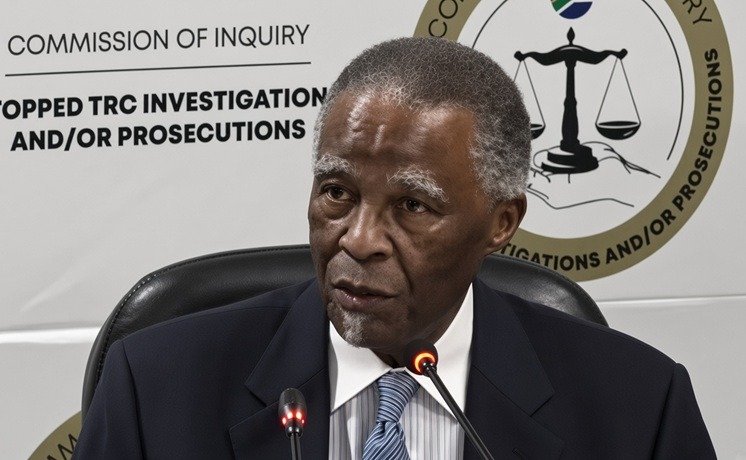
Mbeki appeared before the Truth and Reconciliation Commission (TRC) Cases Inquiry in Newtown, Johannesburg, on 19 October 2026.
The establishment of the judicial commission of inquiry – chaired by retired Constitutional Court Justice Sisi Khampepe, assisted by retired Northern Cape Judge President Frans Diale Kgomo and Advocate Andrea Gabriel SC – followed an application by families and victims of apartheid-era crimes, in the Gauteng Division of the High Court.
The families, who include the Cradock Four – slain Eastern Cape anti-apartheid activists Matthew Goniwe, Sicelo Mhlauli, Fort Calata and Sparrow Mkonto – seek declaratory orders and constitutional damages for the NPA failure to investigate or prosecute cases, identified by the Tutu-era TRC.
Mbeki faced allegations that his administration interfered with the National Prosecuting Authority’s (NPA) work on the TRC cases.
He also had to answer allegations that he and former president FW De Klerk took part in meetings with leaders of the SADF, the South African Police (SAP), and the African National Congress (ANC), where they agreed to find a political solution to avoid prosecutions.
Another allegation against Mbeli was that he authorised, or was the source of authorisation for, the suspension of planned arrests in the Reverend Frank Chikane matter in 2006. Chikane was poisoned in 1989 when apartheid security branch operatives secretly laced his clothing with an organophosphate nerve agent.
Law and Order Minister Adriaan Vlok and several former high-ranking officers pleaded guilty to attempted murder and received suspended prison sentences in 2007.
Responding to the allegations, Mbeki said neither he as president nor his cabinet had the authority to direct prosecutors to pursue or abandon criminal cases.
He has also rejected allegation that his administration adopted a policy to prevent the investigation or prosecution of these cases.
Mbeki argued that prosecutors and the NPA inherited from the old order were intent on protecting those responsible for crimes committed under apartheid. He said they sought to “protect their criminal offence from discovery by surrounding it with the bodyguard of lies”.
On the allegations of secret meetings with former apartheid generals to help them avoid prosecution, Mbeki said they were a “complete fabrication”.
Mbeki said a meeting was held with the generals. However, they discussed the generals’ request that National Party leaders testify before the amnesty committee first, providing details of the orders they gave to the foot soldiers. The foot soldiers would then testify about how they carried out those orders.
“It’s a complete fabrication. There’s no such thing. There are no such meetings that took place in order to secure amnesty for them,” Mbeki told the commission.
Led by advocate Ngwako Maenetje, Mbeki told the commission that his speech to Parliament in April 2003 had made it clear that he was dealing with matters not dealt with by the TRC and this had not been an attempt at political interference.
“The establishment within the NPA of a specialised prosecutorial capacity capable of pursuing these matters is difficult to reconcile with the suggestion that my purpose shortly hereafter was to signal that those cases should be suppressed,” he said.
The unit was established in March that year, and advocate Anton Ackermann was appointed to head it, he said, adding that “selective” quoting from his speech was “disingenuous and misleading”.
He denied allegations that the NPA required permission from the government before pursuing cases referred to it by the TRC.
With regard to the matter of presidential pardons for those who had not applied, Mbeki said that “for the relevant pardon cases it was desirable to replicate the processes of the TRC 1993 [amnesty] unit” which had since been disbanded.
In the interests of the National Reconciliation and TRC Acts, he said, while the NPA continued its normal work, it was encouraged to collaborate with intelligence agencies “for those who sought to disclose the truth to enter into arrangements with the NPA”.
He said his statement had made it clear that the government’s approach had been not to grant immunity or general amnesty, but to “encourage truth telling”.
“My reference to the NPA working with intelligence agencies simply underscored need for cooperation between state institutions that offences were politically motivated. It did not mean intelligence needed to control information. It was aimed at sharing information,” said Mbeki.
In response to criticism surrounding post-TRC prosecutions, he said the government had decided to establish “a more structured and transparent framework for evaluating future pardon requests” as announced by his then minister of justice Bridgette Mabandla in January 2007.
He emphasised that the presidential pardon powers applied strictly to those who had already been convicted of an offence in a court of law.
He also challenged assertions by Lukhanyo Calata, son of Fort Calata, that the government and successive ANC-led administrations – including Mbeki – failed TRC victims and families.
In an ANC Radio Freedom audio broadcast played before the TRC, Mbeki who addressed South Africa from exile in 1985 – on the eve of the mass political funeral of the Cradock four said: “Compatriots, tomorrow at Cradock in the Eastern Cape, we shall be burying our leaders.”
“Today, their names stand at the head of the list of heroic martyrs whom the enemy has murdered in cold blood – as part of its continuing war of repression against the people.”
The former statesman said an accusation by the Calata Group, representing the families and survivors of various apartheid-era atrocities, that his special dispensation had adopted the “political solution” that had been sought by the apartheid security forces of an admission of crimes without full disclosure, was untrue.
Mbeki concluded his testimony, denying that his administration had ever adopted policy or made any attempts to “halt, delay, or suppress the investigation and prosecution of TRC cases”.