
By Lehlohonolo Lehana.
Government has announced that it will reduce operations at the Musina Temporary Repatriation Processing Centre (TRPC) from 1 August, citing a sharp decline in the number of undocumented foreign nationals requiring processing.
The centre, which was established in June to respond to increased migration pressures and facilitate orderly repatriations, will see its capacity reduced from 20,000 to 1,500 people.
Justice and Constitutional Development Minister Mmamoloko Kubayi says government remains committed to strengthening migration management, while ensuring that humanitarian support and constitutional obligations remain central to its approach.
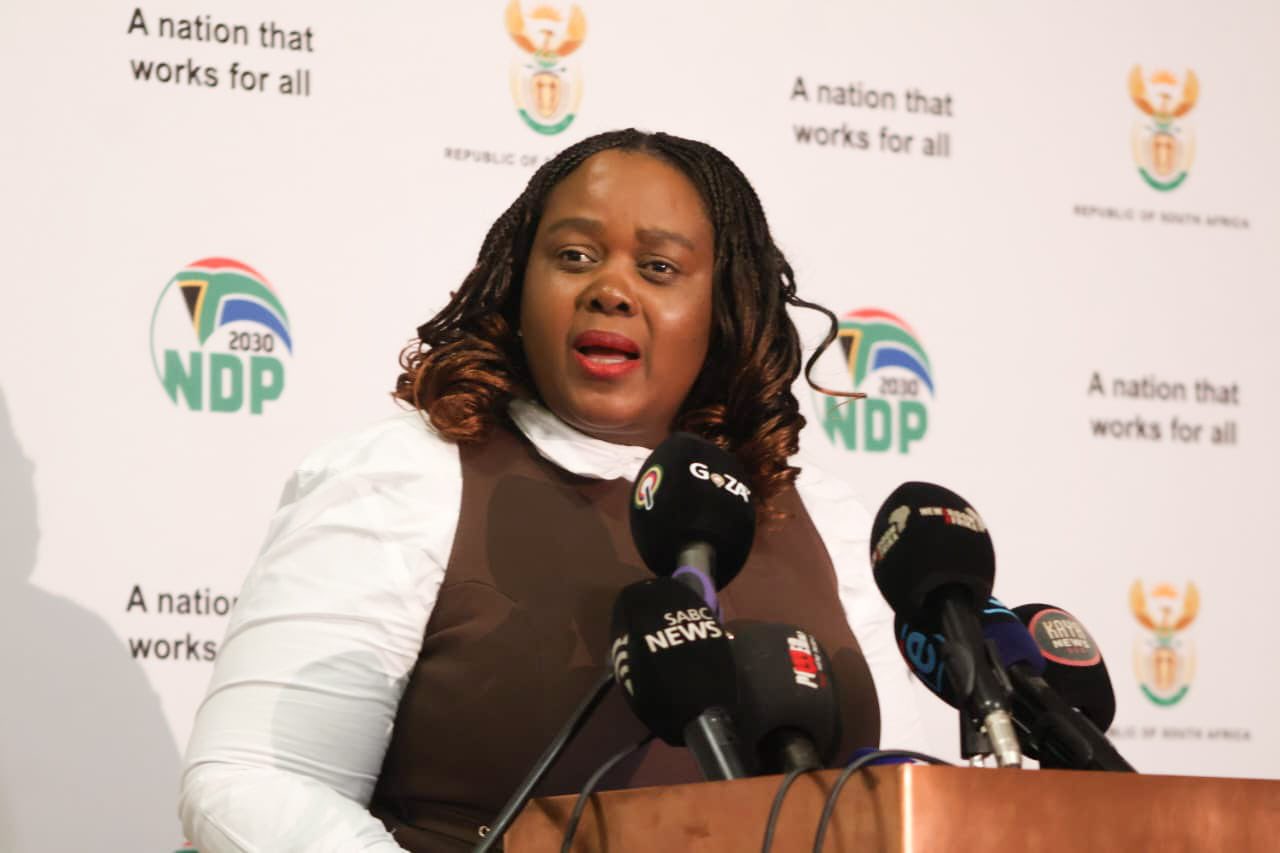
Kubayi, alongside Minister of International Relations Ronald Lamola and Minister of Police Feroz Cachalia were delivering a progress report on the implementation of the Five-Point Plan on Sunday.
The plan focuses on:
- Cracking down on immigration and labour law violations;
- Strengthening border security;
- Stamping out corruption in the immigration system;
- Closing legal loopholes in migration policies; and
- Working with other African countries.
“The IMC has taken a decision at its regular meeting on Friday, 24 July 2026, that as of the 1st of August 2026, operations at the TRPC will be scaled down from 20 000 capacity to 1 500 capacity, after analysis of data trends for the past three weeks,” Kubayi said.
The Minister said the phased reduction in operations will not compromise government’s ability to process undocumented foreign nationals or carry out deportations and repatriations.
“We envisage that the phased scaling down of the centre will not negatively impact or compromise both the deportation and repatriation processes we are undertaking.”
“The State remains with the legal obligation to continuously manage the issue of migration in the country and will continue to do so guided by the Five-Point Plan and immigration laws of our country, and the work being monitored by Cabinet,” she said.
Kubayi said government has made significant progress in processing undocumented foreign nationals since migration pressures intensified in June.
“Regarding deportations and repatriations, we can confirm that since Malawian nationals assembled at Sherwood in KwaZulu-Natal between the 14th of June 2026 to 24 July 2026, a total of 68 138 foreign nationals have been processed, with the majority repatriated following processing at the Musina Temporary Repatriation Processing Centre,” she said.
Kubayi said South Africa’s dedicated immigration courts have also been processing migration-related matters at an accelerated pace.
She said between 1 April and the end of June, immigration courts finalised 28 736 immigration-related cases, mainly dealing with deportations.
Of these, Gauteng accounted for 13 312 cases, representing 46% of the total, while KwaZulu-Natal finalised 4 973 cases, most of them through the dedicated courts in Durban Central and Sherwood. The Western Cape completed 3 334 cases and the Eastern Cape finalised 2 019 cases.
Government is now working to establish a dedicated immigration court at OR Tambo International Airport on a site identified by Airports Company South Africa (ACSA), while upgrades to the Lindela Court at the deportation facility are also expected to commence.
Lamola criticised Ghana’s intention to take South Africa to the AU over migration tensions, as the continental body prepares to meet this week.
Two Ghanaians have also petitioned the International Criminal Court (ICC) to investigate repeated xenophobic attacks in South Africa.
Lamola has dismissed the allegations as cheap political point-scoring against South Africa.
“This debate that is being called by Ghana should not be a debate of finger-pointing and cheap political scoring against South Africa because it will not be helpful. It should be a constructive engagement on migration.”
Lamola explained that the protocol, adopted by the African Union in 2018 as a flagship project under Agenda 2063, promotes coordinated migration management, stronger border systems and enhanced efforts to combat human trafficking.
He noted that the Southern African Development Community (SADC) also has a Protocol on the Facilitation of Movement of Persons, of which South Africa is a signatory, although more member states are still required before it can be operationalised.
“But both protocols call for regular and orderly migration, which is a point of emphasis that migration must be orderly, must be regular, and must also be legal,” the minister said.
However, he stressed that concerns raised by many countries relate not to the enforcement of immigration laws, but to incidents where private individuals or groups take the law into their own hands.
“The only issue that all of them do raise… is that where there is a challenge of irregular and illegal, including undocumented immigrants, it must be dealt with in a human way. It must be dealt with by law enforcement, not private individuals and groups that are not mandated by the laws of that country,” Lamola said.
He said government would continue engaging with countries across the continent to reinforce this principle.
Lamola said discussions at the AU should move beyond focusing exclusively on South Africa and instead examine the broader drivers of migration across the continent.
He noted that South Africa receives the highest number of migrants in Africa, both regular and irregular, while North African countries also experience significant migration pressures as destinations and transit routes to Europe.
Responding to questions about his recent visit to Ghana as President Cyril Ramaphosa’s Special Envoy, Lamola dismissed suggestions that the South African delegation had been rejected.
“I went to Accra, Ghana, as the Special Envoy of the President, and I was well received by President Mahama with the Minister of Foreign Affairs of Ghana and his delegation,” he said.
He said discussions reaffirmed the longstanding relationship between the two countries, which dates back to the struggle against apartheid.
“The meeting reaffirmed South Africa-Ghana relations that this matter on the table is not going to impact or affect South Africa-Ghana relations because the relationship between Ghana and South Africa is enduring,” he said.
Lamola said Ghana acknowledged South Africa’s sovereign right to enforce its immigration laws but raised concerns about violence associated with protests over migration and incidents where individuals impersonate law enforcement and Home Affairs officials.