
By Lehlohonolo Lehana.
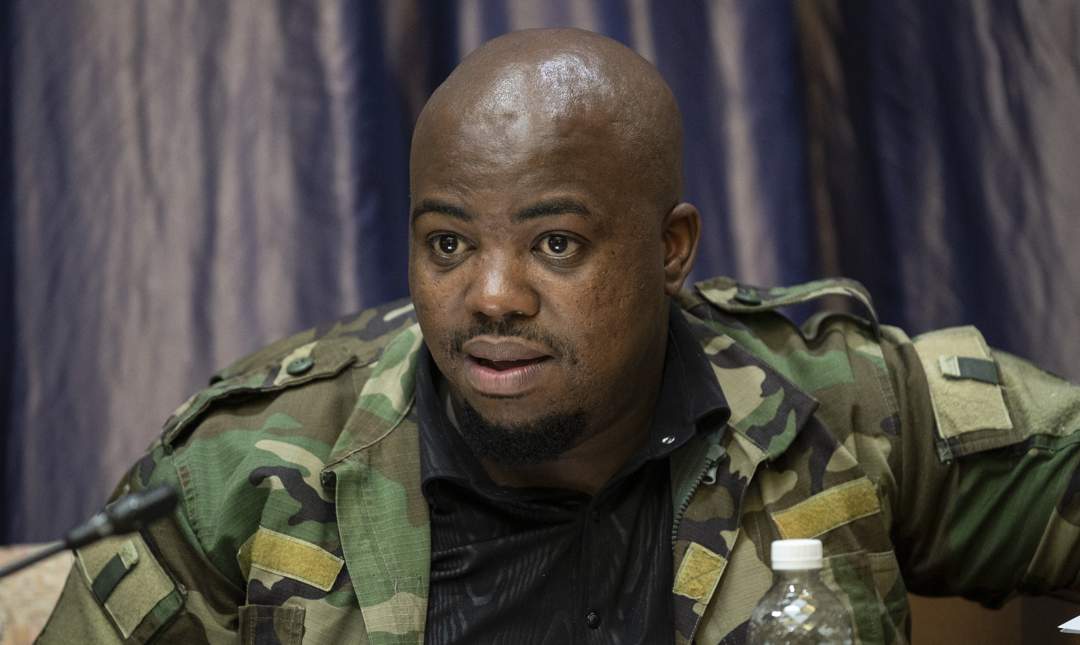
uMkhonto weSizwe (MK) Party Secretary-General Sibonelo Nomvalo says all individuals entering South Africa must do so through legal and documented channels.
In a media briefing on Thursday, Nomvalo told journalists that undocumented foreigners have taken over parts of towns and cities and reduced them to centres of crime.
“There are areas which have been surrendered by South Africans because of illegal immigrants. Our understanding is that March and March are not fighting legal immigrants. They are fighting against people who have broken the law. If you are called an illegal immigrant, it means you have broken the law because you are here illegally,” he said.
Nomvalo said the state found it difficult to trace undocumented foreigners when they had committed crimes in South Africa. He accused undocumented foreigners of establishing drug cartels and criminal syndicates.
However, he stressed that the party had not endorsed it, saying, “The MK Party has neither formally aligned itself with nor endorsed March and March.”
Nomvalo said the party supports the constitutional right to peaceful protest and mass mobilisation, adding that it would not restrict its supporters from participating in demonstrations.
He also said immigration must be addressed strictly within the framework of the law, adding that those in the country unlawfully should consider voluntary repatriation.
On Tuesday, President Cyril Ramaphosa spoke strongly against illegal immigration and xenophobia.
Ramaphosa said the government was taking decisive action to address illegal migration challenges by cracking down on violations of immigration laws and increasing inspections of workplaces and prosecuting employers who violate labour laws.
Tabling the budget vote of the Presidency, he said there was a need to address the challenge of migration and work was being done to build a safer, more stable and more prosperous society.
Nomvalo has also confirmed that the party will announce its mayoral candidates for all eight metropolitan municipalities within the next two weeks.
He said the party would field candidates in Johannesburg, Cape Town, Tshwane, Ekurhuleni, eThekwini, Nelson Mandela Bay, Buffalo City and Mangaung.
“The organisation is going to ensure that local government public representatives who will be contesting on behalf of the MK Party are known, trusted and chosen by the communities they wish to represent, and have the human compassion and technical capabilities required to listen to our people and to deliver services that unlock local government potential,” he said.
He said the party had completed more than 50 regional consultative meetings across districts and metropolitan areas as part of its national election preparation programme aimed at strengthening structures and mobilisation capacity.
“After careful deliberation and analysis of the enormous task of preparing a demanding elections programme across the country, the National Officials decided to strengthen the provincial elections task teams,” Nomvalo added.
Nomvalo also said that the party would continue with its legal challenge against the Independent Electoral Commission (IEC), with a court case scheduled for 18 June 2026 at the Johannesburg High Court.
As part of its organisational build-up, the MK Party confirmed internal deployments to strengthen provincial election structures.
In Mpumalanga, Nomvalo said deputy president Tony Yengeni had been deployed as provincial elections convener, while Lindiwe Mtshali, secretary of the Women’s League, had been appointed provincial elections coordinator. Qiniso Cibane was deployed as provincial organiser.
In the North West province, Aleck Nkuna, had been deployed as provincial elections convener, supported by Nomusa Dlamini as provincial elections coordinator and Nkateko Mkabela as provincial elections organiser.
Nomvalo said, the changes form part of a broader strategy to consolidate internal operations as the party prepares to expand its presence in municipalities nationwide ahead of the 2026 polls. The party made significant gains during the 2024 general elections, particularly in KwaZulu-Natal, where it emerged as a strong political force.