
By Lehlohonolo Lehana.
Mpumalanga government says it is exploring plans to diversify the local economies to reduce dependency on coal as South Africa works towards transitioning towards green energy sources.
Delivering the State of the Province Address on Friday, Premier Refilwe Mtshweni-Tsipane, said the provincial government is working with the Presidential Climate Commission, the Climate Investment Fund and the World Bank to explore plans on re-skilling and upskilling the most vulnerable in the labour force and supporting small businesses and co-operatives in local communities.
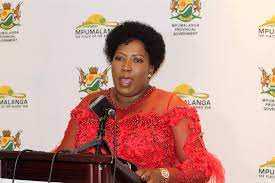
This is the 5th SOPA to being delivered by Mpumalanga first woman premier since taking over the helm of the provincial executive in 2018.
In her speech, she discussed the province’s plans, challenges and achievements.
These issues ranged between job creation initiatives, investing in Mpumalanga economy, bulk water infrastructure, infrastructure development, strengthening the healthcare system post-pandemic, game-changing interventions and support for traditional leadership.
Through the Political Declaration issued in November 2021 to establish this partnership, the United Kingdom – together with the European Union, France, Germany, and the United States – undertook to mobilise an initial amount of $8.5 billion over the next three to five years to support the achievement of South Africa’s ambitious Nationally Determined Contribution (NDC).
The NDC is a climate action plan aimed at cutting emissions and adapting to climate impacts.
“Those who work in these coal mines, those who work in these power stations, those who provide goods and services to these coal mines and power stations, those who depend on the workers and service providers to these mines … those are our people, and those are the people we are most concerned about.
“They should not be left behind. The transition will not be just if it fails to ensure that these constituencies of ours are not left behind,” the Premier said.
Mtshweni-Tsipane said old mines should be rehabilitated, and in the process the vast tracts of land be gainfully utilised in the new industries that conform with the Just Transition principles – such as manufacturing, agriculture and assembly of solar voltaic panels, wind turbines, batteries and others.
“We would also like to see our people participate and derive benefit from small scale, surface mining and other beneficiation opportunities,” the Premier said.
Empowering youth owned businesses
Through the Youth Development Fund, the province has in the current financial year approved 36 companies for funding, with a total amount of R92.3 million disbursed thus far.
The ownership of these companies comprises 60 males, 45 females and five youth with disabilities.
“These youth-owned enterprises are within sectors that are inclusive of mining, agriculture, manufacturing, transport and logistics. Beneficiaries of the fund are spread all over the province, with the effect that every single one of the 17 local municipalities is home to at least one beneficiary,” the Premier said.
Since its inception, the project has empowered 97 youth-owned businesses across the province and funding to the tune of R140 million was allocated to them.
Recently the province advertised the 2023 Premier’s Youth Development Fund, with the intention to increase the participation of youth with disabilities and youth in rural areas.
The call for applications will close on 17 March 2023.
“We intend to set aside at least 30% of funding for applications coming from the designated applicants, particularly people with disabilities from the rural areas.
“Apart from funding their enterprises, we also provide pre- and post-investment support.
“Through the Expanded Public Works Programme (EPWP), we continue to create the much-needed work and training opportunities for the poor and unemployed. In the current financial year, EPWP has created 24 205 work opportunities through the use of labour-intensive methods.
“The majority of beneficiaries in this regard are youth, women and people with disabilities. Our Fortune 40 programme, which has been running for a period of more than five years, has reached maturity and is now producing young commercial farmers,” the Premier said.
The province expects to create at least 90 000 youth job opportunities within the next 15 months.