
By Lehlohonolo Lehana.
Secretary to Parliament Xolile George released an investigation report into the blaze which gutted parts of the National Assembly, finding that Parliament did not meet minimum security standards.
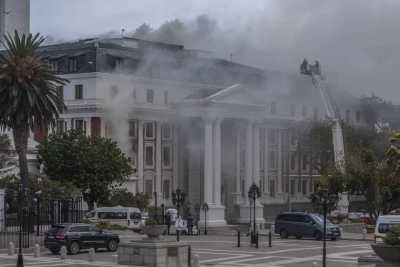
A fire broke out in January last year, damaging the buildings that house the chambers of the National Assembly and critical offices of Parliament.
The fire took three days to contain and required the labour force of over 300 men and women.
Speaking during a media briefing, George revealed the investigation concluded that the blaze could have been avoided if the minimum standards, such as a high perimeter fence, had been adhere to.
George said the 1.3 metres fence allowed Zandile Mafe, who was arrested in connection with the fire, to gain “unauthorised access and to enjoy unrestricted movement within Parliament without being detected for a number of hours beyond a day”.
Mafe, is still awaiting trial, the 50-year-old faces several charges, including terrorism.
He previously admitted to torching the National Assembly in court and threatened to burn more of it, should the Democratic Alliance (DA) continue being part of the National Legislature.
In August, Mafe was declared unfit to stand trial, meaning that his case will now be handled under section 77 of the Criminal Procedure Act, which refers to an accused who suffers from mental illness.
Parliament was informed by the South African Police Service (Saps) last year that the fence should have been upgraded to 3 metres as part of security improvements.
“What the investigation identified was a range of systems and maintenance failures that significantly contributed to the security breach and the failure to prevent and contain the fire.
“These failures encompassed issues such as the height of the perimeter fence I mentioned earlier and the absence of perimeter monitoring in terms of physical presence of security.
“A malfunctioning emergency exit door was also identified on the physical aspects, as well as deficiencies in the final fire panels and an unreliable fire management system,” George explained.
George said the decision not to deploy and put Parliament Protection Services (PPS) officials on compulsory leave in lead up to the incident was also a contributing human factor to the fire.
The absence of PPS officials meant there was no one available to monitor CCTV cameras.
The report also pointed out the absence of a designated head of security.
The investigation, George said, further picked up the lack of an active monitoring structure that will regularly keep tabs on the adherence of security policies.
“We are actually giving priority on the issue of security, starting with the appointment of the head of security.”
The investigation further found several CCTV cameras were not working and the fire alarm panels, smoke detector and sprinkler systems were not functioning.
In addition, George confirmed the five officials were found to be responsible or implicated in a number of areas that constituted the failures in the report.
The police and Department of Public Works and other stakeholders were also found to be responsible.
“It is recommended that the findings related to their involvement be disclosed in an appropriate forum. Additionally, consequential management and remedial actions will then be determined and taken to address those departments and agencies that are concerned.”
However Democratic Alliance (DA) Chief Whip Siviwe Gwarube says the buck stops with Speaker Nosiviwe Mapisa-Nqakula and Chairperson of the National Council of Provinces (NCOP) Amos Masondo.
“The Powers, Privileges and Immunities of Parliament and Provincial Legislatures Act stipulates that the Speaker and the Chairperson exercise joint control and authority over the precinct on behalf of Parliament,” says Gwarube.
“I will be writing to the Acting Speaker, Lechesa Tsenoli and the Acting Chairperson of the NCOP, Sylvia Lucas, urging them to urgently table the report before the Joint Standing Committee of Financial Management of Parliament for public discussion and interrogation.”
“We need to understand who is to be held accountable and how the Executive Authority will take responsibility for the fire that will be remembered for decades to come. Accountability must begin in Parliament before it can be exercised over the executive,” she adds.