
By Lehlohonolo Lehana.
The residents of Hammanskraal will now have to wait five more months for the construction of a packaged wastewater treatment plant to be completed.
The plant made headlines last year after a cholera outbreak which killed 23 people at Hammanskraal, with controversial businessman Edwin Sodi’s R295-million tender contract to upgrade the plant’s infrastructure being scrutinised.
The SIU has since been investigating the refurbishment and upgrade project, of which only 60% of the first phase was completed before it was abandoned in 2020.
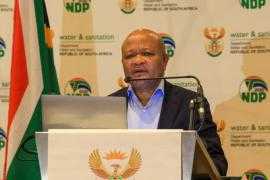
Water and Sanitation Minister Senzo Mchunu, joined by Tshwane Mayor Cilliers Brink, conducted an oversight project inspection of the Rooiwal Wastewater Treatment Works (WWTW) and Klipdrift Package Plant in Hammanskraal, north of Pretoria.
The inspection come as the department, through its entity, Magalies Water, and the City of Tshwane are working collaboratively to effectively address water challenges affecting most parts of Hammanskraal.
Speaking during a community imbizo held at Mandela Hall, Mchunu recommitted to oversee the successful refurbishment of the Rooiwal Wastewater Treatment Works to enable its performance at optimum capacity, as well as the upgrading of the Klipdrift Water Treatment Works.
“As a Ministry, we made a commitment to ensure the provision of equitable and excellent quality water supply, as well as dignified sanitation for all. Therefore, our visit to Hammanskraal is by no means just for show, nor is it politicking, “Mchunu said.
The Ministry and the City of Tshwane also informed the community that work is underway to upgrade the Klipdrift Water Treatment Works, which is set to get upgraded from 42 to 92 mega litres per day, to improve the provision and quality of water in parts of Hammanskraal.
“I am pleased to inform you that by September this year, most households will be able to get consistent and reliable water in their homes. This will significantly improve the quality of life for more than 47 000 households and a population of 180 679,” Mchunu said.
Giving an update on the latest progress made towards the refurbishment of Rooiwal Wastewater Treatment Works, Mchunu reported the Development Bank of Southern Africa (DBSA) has been appointed as the implementing agent to complete the refurbishment of the plant.
He said the work to be carried out will include two sub-phases.
“Phase 1A of the refurbishment is urgent, and a turnkey approach is undertaken to ensure that the necessary works are carried out swiftly and efficiently. This includes both general building and mechanical, and electrical elements that will work together to deliver the upgrades needed to improve the Plant’s capacity and functionality.
“Phase 1B will follow a conventional approach, which will see the construction of two primary sedimentation tanks, the refurbishment of the east flow balancing tank and pump station, and the upgrading of the anaerobic digesters on the Rooiwal West Works, amongst others,” Mchunu explained.
The Minister highlighted the socioeconomic benefits that the two projects will bring to the area of Hammanskraal and surrounding areas.
Brink said plans to upgrade the Rooiwal Wastewater Treatment Works are on track, as they prioritise security.
He said not repeating past mistakes was something they would prioritise as the city continues with the upgrade of the plant.
This includes avoiding contracts with compromised individuals.
“Upgrading Rooiwal is for the longer term. What we want to avoid are some of the mistakes that were made in the past with compromised contracts with people implicated in state capture becoming involved. That is our main project, to ensure that it doesn’t happen at Rooiwal,” said Brink.
The second aspect, courtesy of the department of water and sanitation is the package plant. The value of the package plant is that it allows us to eliminate water tanks and immediately you say that you realise the risk that this project faces from sabotage from vested interests. We will cooperate as different spheres of government to secure the package plant because people don’t want water from tankers, they want water from the taps.”
Brink said they were busy building a 1 000-metre fence to secure Rooiwal to stop anyone from sabotaging the work that’s being done.