
By Janine Greenleaf Walker.
South Africa is where it is because its leaders take themselves too seriously and lie about serving the people, former South African Revenue Service (SARS) Commissioner Professor Edward Kieswetter has said.
“Our country is where it is because leaders take themselves too seriously instead of taking their work seriously,” he told delegates at the recent 4th Universities South Africa (USAf) Higher Education Conference in Tshwane. “They lie. They lie about serving people and instead serve themselves. And it is a reality that we must face up to.”
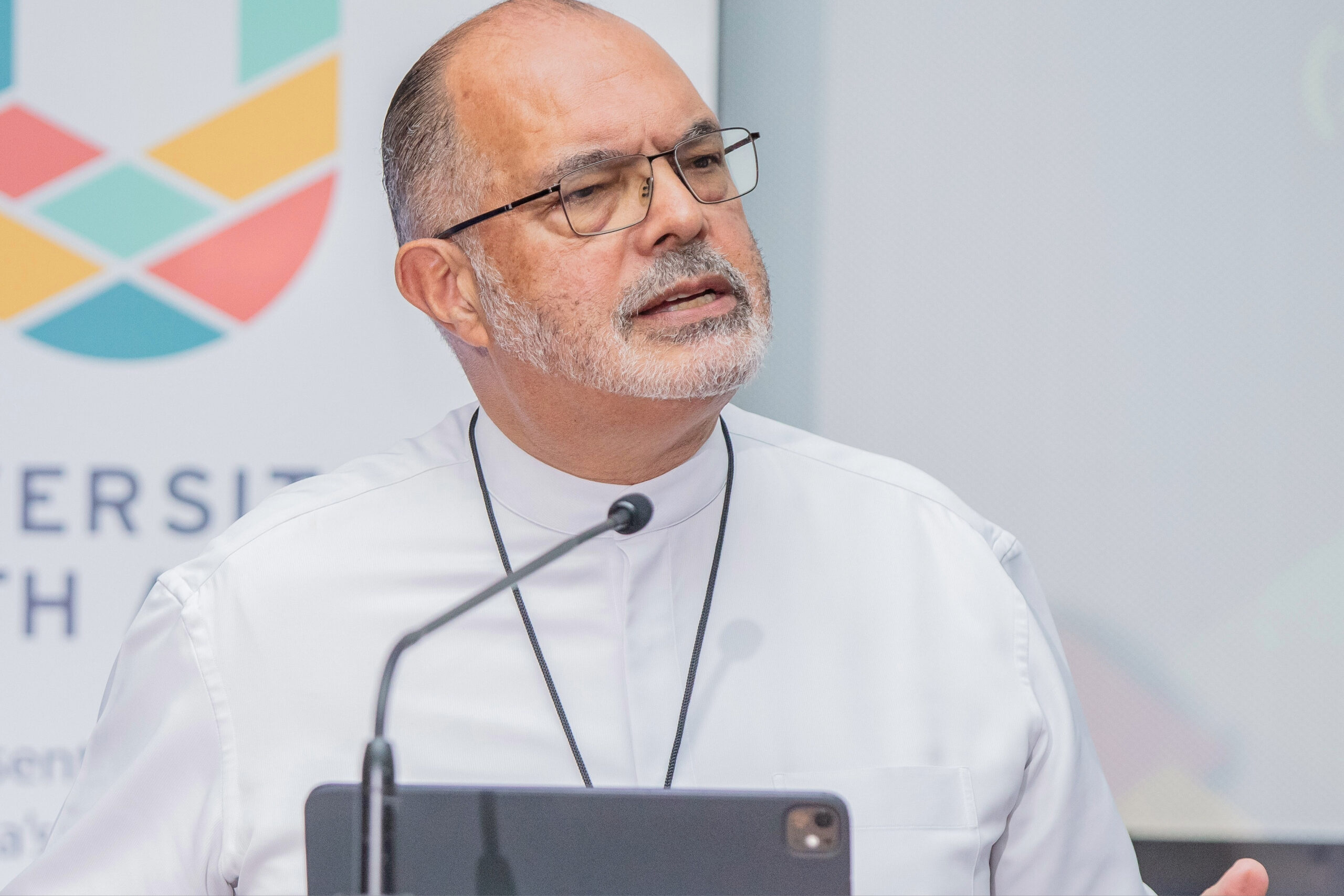
Kieswetter, who led SARS from 2019 until April 2026 and is President of the Da Vinci Institute of Technology and Innovation Management, was delivering a keynote address on governance, accountability and renewal. He argued that institutions, universities among them, will only survive the disruption ahead if they are built on honesty, integrity and trust.
“We have set the leadership bar too low,” he said. “Most leaders overestimate their own ability and underestimate the size of the job.”
He set out five tests for anyone appointing a leader. The first is good character. “You can’t learn character at school,” he said. “When you appoint a leader who has poor character, you have not appointed a leader; you have appointed a problem.”
The second is competence. The third is a track record. Citing former General Electric chief executive Jack Welch, he said a would-be leader should first be given “a popcorn stand”, then the corner café, then the provincial store, and only then the company.
The fourth is work ethic. “Leaders are not postboxes. If leaders are not the hardest workers in their organisations, the organisation will fail.” The fifth is to be incorruptible, and to refuse anything “that, if it appeared on the front page of a major newspaper, they would be ashamed of”.
Kieswetter warned that universities face a future none of them can map. “A student who enrols with us this year will graduate into a labour market that none of us can fully describe,” he said, “and in many respects a labour market that does not even exist.”
Within three to five years, he predicted, artificial intelligence agents would do all cognitive tasks better than people. That raised an uncomfortable question. “What is a university actually for, in a world where a machine can out-argue your best law student, and in fact all the best law students combined, and will out-diagnose your medical registrar?”
“The honest answer has to be something closer to saying that a university exists to prepare young people to navigate what does not yet exist,” he said. “The future cannot be about degrees and qualifications as much as it must be about proven credentials that improve social impact.”
That cannot happen in “a place that changes its curriculum once a decade and then, when it applies for it, waits another decade for it to be approved”, he said. “Agility is not an optional extra anymore.”
But speed without a foundation is dangerous. “Agility without the proper anchoring is in fact just reckless drifting, “he said. A self-confessed Formula One fan, he compared institutional resilience to a racing car’s chassis, which spectators never notice. “Resilience is not the brake on agility. It is the chassis that allows it to fly at super speed.”
He drew on his own record. When he became Group CEO of Alexander Forbes in 2010, the financial services group faced a billion-rand civil claim, 21 potential criminal charges and a R3.5 billion tax risk. One financial journalist, he recalled, wrote in effect: “Kieswetter, are you stupid?”
In his first briefing, he listened to the chief financial officer and legal counsel for about ten minutes, then asked why the company was defending itself. Because it was being attacked, they said. “And I said: well, if we are defending ourselves, who is defending the pensioners who suffered as a result of this inexcusable scheme? And they did not answer.”
That question, he said, “did not just change our legal strategy; it changed the DNA of the institution”. The company pleaded guilty, and R730 million went back to pensioners. In July 2014, a company “that we could not sell in 2010” listed on the stock exchange, three and a half times oversubscribed.
“What changed the organisation was not a better strategy or a clearer vision. It was building trust, one moral act at a time.”
The same thinking guided his time at SARS. “Nowhere in this playbook will you see the words, as part of our strategic intent, ‘We must collect more taxes’,” he said. Instead, SARS promised clarity, better service and fair enforcement. Over seven years, he said, independently measured public trust in SARS rose from 48% to 75%, satisfaction with its service rose from 54% to over 90%, and the revenue service achieved record collections.
Trust, he said, is “your most valuable asset, even though it is nowhere on your balance sheet”. “Trust is not won by a better press statement. It is won by consistent delivery, transparency and fairness, repeated until people believe it.”
He urged leaders not to become complicit in dishonesty, “including when the dishonesty comes from your bosses”, and to look for the real state of their institutions in what front-line staff experience, “not the state that is in the glossy report or the annual report”.
“Culture is shaped by the worst behaviour a leader is willing to tolerate,” he said. And leaders must plan for the day they leave. “We build too many institutions around individuals.”
He ended with two questions that every leader should ask themselves. “What do you, as a leader, truly stand for? And is it a goal so worthy that you are prepared to die for it? Leaders, in my opinion, must take their work seriously, instead of taking themselves seriously.”