
By Kevin Rademeyer, Sports Journalist.
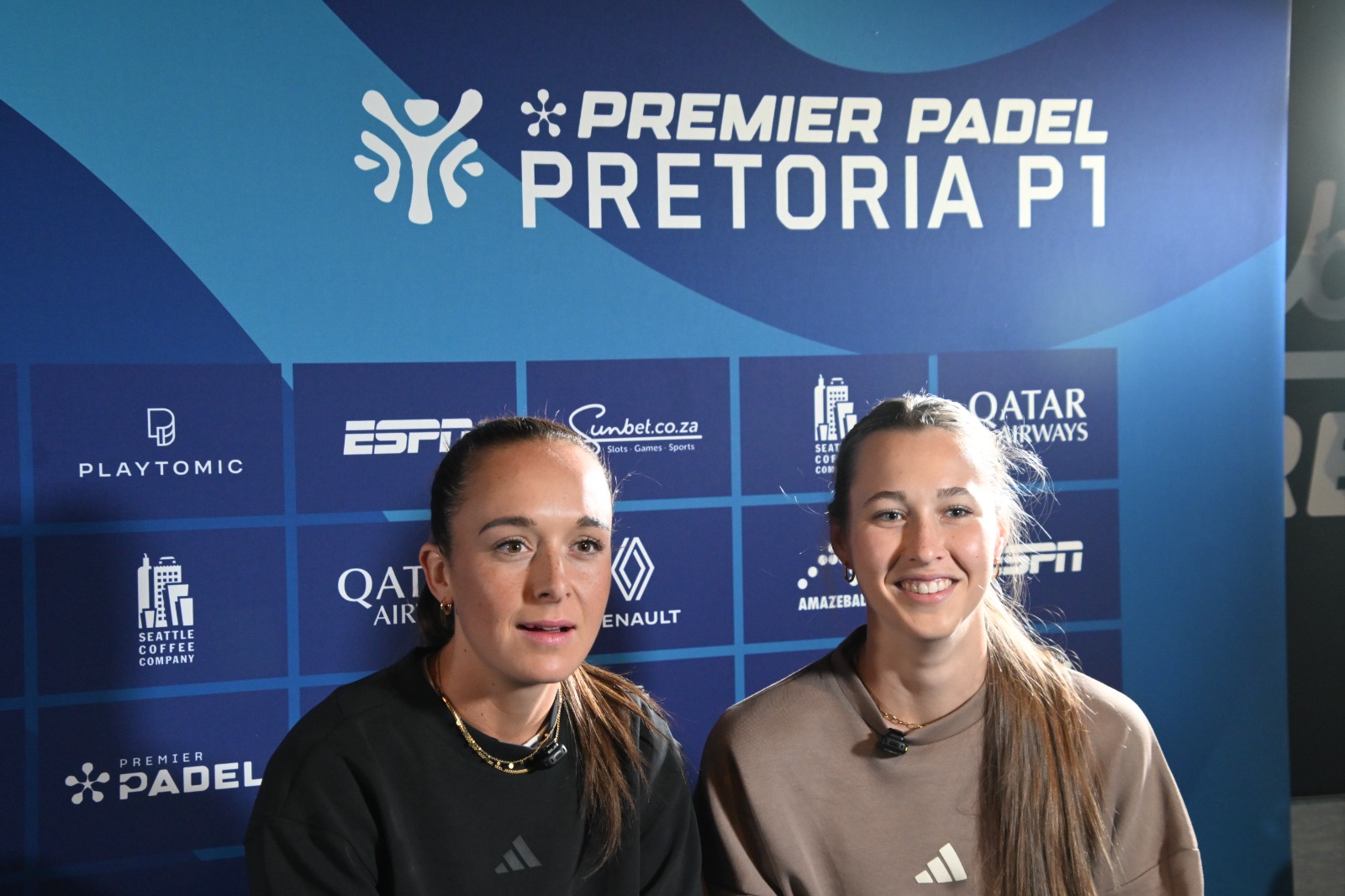
Caption: Zoe Kruger and Linge Steenkamp at Media Day. Photo Credit: Suresh Rajcoomar/Fullview.
Live from Sunbet Arena, Pretoria: The South African challenge may have come to an early end at the Premier Padel Pretoria P1, but in truth the result was never the story. This week was always about far more than wins and losses. For the first time, the world’s premier padel circuit has arrived on African soil, bringing the sport’s biggest names to Pretoria and offering South African players a rare glimpse of the standard they must chase if they hope to compete among the elite.
There were moments of encouragement. There was also a healthy dose of reality.
By the end of Tuesday, every South African pairing had been eliminated from the tournament, leaving the SunBet Arena stage to the established stars of Spain, Argentina and the rest of Europe, where professional padel has long since become a way of life rather than an emerging sport.
South Africa’s leading men’s pair, Luan Krige and Richard Ashforth, were unable to find a way past Spain’s Pol Hernández Álvarez and Guillermo Collado Losada, going down in straight sets. Earlier, Edmond van Heerden and Jason Blakey Milner suffered the same fate against Argentine combination Valentino Libaak and Gonzalo Alfonso, while Warren Kuhn and Adam van Harte bowed out on Tuesday after a 6-4, 6-1 defeat to Spaniards Marcel Font and Pablo Reina Ambel.
The women’s draw told a similar story. Former tennis player Zoë Kruger and partner Linge Steenkamp were beaten 6-2, 6-0 by qualifiers Borrero and Baldi, while Tamara Pieters and Simoné Roets were comfortably defeated by Spanish duo Fassio and Eugenio.
The scorelines reflected the gulf that still exists between South Africa and the world’s leading padel nations, but they hardly tell the full story.
Krige and Ashforth have only been playing the sport since 2023. Kruger only began taking padel seriously four months ago, while Steenkamp contested her first tournament just a year ago. Against opponents who have spent their entire sporting lives immersed in the technical demands of padel, experience was always going to outweigh enthusiasm.
That distinction matters.
Padel may share some familiar strokes with tennis, but at elite level it quickly becomes a different game entirely. The use of glass, the angles, court positioning, anticipation and decision-making are all learned through thousands of hours on court. Powerful groundstrokes alone are no substitute for understanding how to manipulate space inside a padel court.
Even so, there were flashes that reminded the Pretoria crowd why the sport has taken such a hold in South Africa.
Ashforth’s spectacular sprint beyond the court to retrieve an opponent’s kick smash before somehow winning the point brought the SunBet Arena to its feet. His partner, Krige, admitted afterwards it left him with goosebumps.
Those moments cannot bridge years of experience, but they can inspire belief.
South Africa’s rapid rise has been remarkable. Public courts only began appearing in 2020. Today there are more than 1 500 courts across 458 clubs, with hundreds more built over the past year alone. Franchise competitions such as the Diamond League have accelerated player development, but local professionals know the next step requires regular competition against Europe’s best.
That opportunity is precisely what Pretoria has delivered. From Wednesday, attention turns fully towards the sport’s global superstars.
World No. 1 pairing Arturo Coello and Agustín Tapia arrive chasing a sixth consecutive Premier Padel title and begin their campaign against the Argentine duo of Libaak and Alfonso. Their combination of power, touch and tactical precision has redefined the modern game and they remain overwhelming favourites.
Waiting to challenge them are fellow heavyweights Ale Galán and Federico Chingotto, Juan Lebrón and Leo Augsburger, Martín Di Nenno alongside the evergreen Paquito Navarro, while several other top eight men’s pairings begin their title pursuit.
The women’s competition promises no less quality. Although World No. 1 pair Gemma Triay and Delfi Brea only enter the tournament on Thursday, alongside second seeds Bea González and Paula Josemaría, Pretoria’s crowds are set to witness many of the finest players the sport has ever produced.
For South Africa, the tournament has become less about local victories than invaluable education.The scoreboards showed the distance still to travel. The experience gained this week may prove far more valuable than a place in the second round ever could have been.
For a country only beginning its journey in professional padel, that is perhaps the biggest victory of all.