
By Lehlohonolo Lehana.
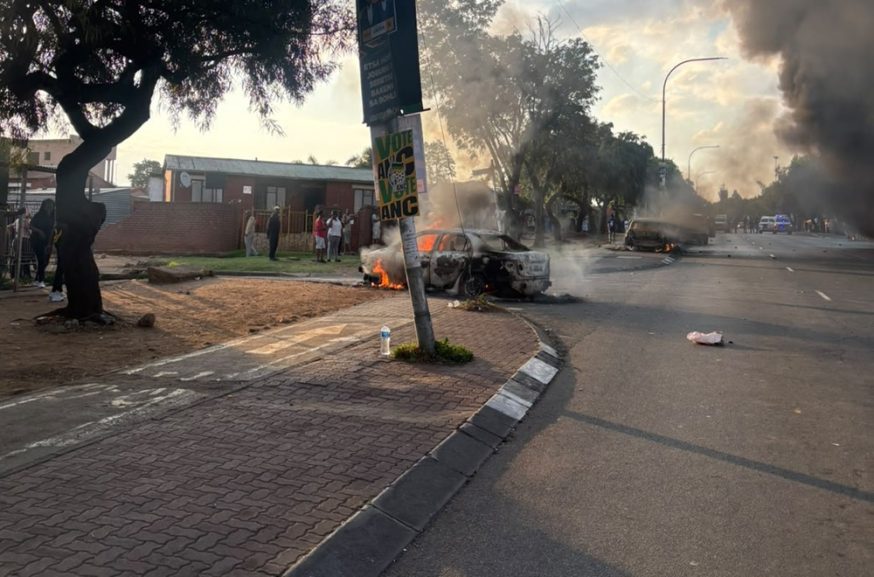
The anti-migrant protests turned violent on Thursday, October 8, 2026, leading to shops being looted and vehicles torched in both Durban and Soweto.
The protests follows the Constitutional Court judgement that all asylum seekers, including people who entered South Africa unlawfully or have no visa, are being given access to the asylum system.
A Home Affairs circular on 28 September states that Refugee Reception Offices must accept applications from every new applicant.
The judgment caused an operational impact after Refugee Reception Offices experienced a significant increase in people seeking to lodge asylum applications.
In Durban a group of protesters demanded that a refugee centre stop processing asylum applications.
Fullview learnt that about 10 vehicles were overturned and set alight, while shops owned by foreign nationals were looted.
Police spokesperson Colonel Robert Netshiunda said the Public Order Police officers and officers from other police units, supported by Durban Metro Police and other role players in the law enforcement sector, are monitoring the protest at the Durban CBD.
In Soweto, clashes erupted between South African residents and foreign shop owners, with gunshots fired.
At least 9 vehicles were set on fire, including incidents reported near Vilakazi Street in Orlando West. Stores were targeted, and goods were set ablaze.
Johannesburg Metropolitan Police Department (JMPD) Superintendent Xolani Fihla said nine vehicles were set alight in the vicinity of the Department of Home Affairs in Soweto.
Fihla said clashes between South Africans and foreign nationals ignited the protest. He said they were investigating allegations that gunshots were fired against the South African protesters, which could have led to the vehicles being set alight.
He reported no injuries and said the situation remained tense.
Briefing media in Pretoria on Thursday, Inter-Ministerial Committee (IMC) on Migration Chairperson and Minister of Justice and Constitutional Development, Mmamoloko Kubayi, said the IMC is working with the Department of Home Affairs, Border Management Authority, law enforcement agencies and other departments to address the immediate pressure on the asylum system.
“The Constitutional Court judgment, handed down in July in the matter of the Scalabrini Centre of Cape Town and another versus Minister of Home Affairs and others, must not be interpreted as legalising unlawful migration or giving people an automatic right to remain in the country,” Kubayi said.
South Africa has seen months of anti-migrant marches this year that have drawn international criticism.
Some of the marches have descended into violence and looting, and thousands of African foreign nationals have fled the country.
Migrants are often blamed for taking jobs, fuelling crime and straining public services, claims that social scientists say are not supported by evidence.