
By Estea Rademeyer, Sports Journalist.
Photo Credit: Getty images.
The ICC Women’s T20 World Cup 2026 has become the most-watched edition in the tournament’s history, attracting 471 million global viewing hours and generating an estimated $93.8 million in economic impact for the United Kingdom.
Post-tournament figures confirm the event’s scale, which set new benchmarks for women’s cricket with record-breaking audiences, attendance, and digital engagement.
Across its 33 matches, the tournament generated 471 million viewing hours globally, representing a 156% increase on the 184 million recorded during the 2024 edition.
The group-stage clash between India and Pakistan in Birmingham became the most-watched match in ICC Women’s T20 World Cup history, attracting more than 77 million viewing hours worldwide. Current indications suggest it was also the most-watched women’s T20 match ever.
Three other fixtures also surpassed previous tournament records, with Australia against India generating 54 million viewing hours, South Africa against India attracting 51 million and Bangladesh against India recording 42 million. Together with the India-Pakistan encounter, they make up the four most-watched matches in the competition’s history.
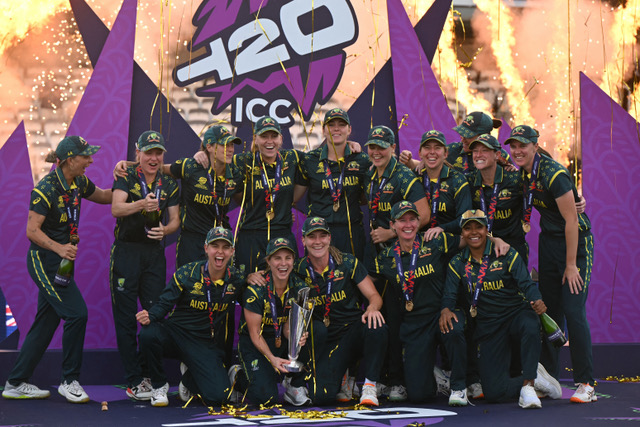
In the host market, the tournament became the most-watched ICC Women’s T20 World Cup on Sky Sports, generating 18.2 million viewing hours. England matches attracted an average audience of 381,000, a 69% increase on the previous edition, while the final against Australia reached a peak audience of 678,000.
Tournament delivers $93.8m economic boost to UK
Beyond its broadcast success, the tournament also made a substantial economic contribution to the host country.
An independent economic impact assessment by Nielsen estimated that the ICC Women’s T20 World Cup 2026 generated $93.8 million in total impact for the United Kingdom. This included direct and secondary economic benefits, as well as media value generated for host cities.
The event also generated or supported more than 13,000 full- and part-time jobs across the UK.
Its social impact was another significant finding in separate Nielsen research, particularly in changing perceptions of women’s participation in cricket.
Among 500 parents of girls aged seven to 15 who had engaged with the tournament, 81% said it had helped challenge the perception that cricket is a sport exclusively for men. The same view was shared by 73% of the 500 women aged 16 to 30 surveyed.
Furthermore, 81% of parents said the tournament had increased their daughters’ interest in joining a cricket club or academy, while 80% believed it would have a positive impact on women’s sport in England.
ICC Chairman Jay Shah said the tournament had demonstrated what could be achieved when women’s cricket received the investment, platform and support needed to grow.
“The ICC Women’s T20 World Cup 2026 has made a powerful statement about the future of the women’s game. This tournament delivered record crowds, viewership, reach and engagement, and demonstrated what is possible when women’s cricket is given the platform, investment and belief it deserves,” Shah said.
He praised the players, the England and Wales Cricket Board (ECB), ICC Members, broadcasters, commercial partners, staff and volunteers for their contribution to delivering the event.
Shah added that the tournament’s success should serve as a foundation for further investment in women’s cricket, expanding opportunities, strengthening development pathways and taking the game to new audiences and markets.
Record attendance and digital engagement
The latest audience and economic figures build on a tournament that had already established new records for attendance and digital engagement.
A total of 245,815 spectators attended matches across the event’s 25 matchdays, surpassing the previous ICC Women’s T20 World Cup attendance record by more than 100,000. The final at Lord’s attracted 28,887 spectators, setting a new record for attendance at a women’s cricket match in the UK.
Digital engagement also reached unprecedented levels, with content across the ICC’s digital platforms generating 3.2 billion views, representing an increase of nearly 250% on the previous edition.
The ICC Creator Club brought together more than 80 content creators from nine countries, producing over 2,000 posts that generated more than 1.1 billion views and 50 million engagements. The JioStar-ICC content creator stream contributed 600 million views.
ICC CEO Sanjog Gupta said the figures reflected a deliberate effort to expand the tournament’s reach through different platforms, markets and forms of fan engagement.
“Nearly 250,000 in-stadia attendees, almost 500 million total global viewing hours and more than four billion digital video views are powerful measures of the global attention the ICC Women’s T20 World Cup 2026 commanded, but the story – and this event’s real-world impact – extends well beyond any single metric, transcending socio-cultural and economic boundaries,” Gupta said.
He highlighted the use of free streaming, digital-first distribution, creator-led storytelling, pop culture partnerships and new fan engagement opportunities as key elements of the tournament’s approach.
Gupta added that ICC events should continue to grow the sport’s global following, elevate its athletes and create lasting cultural, commercial and social value.
With record audiences, significant economic returns and evidence of changing attitudes towards women’s cricket, the 2026 tournament has strengthened the case for continued investment in the women’s game.