
By Lehlohonolo Lehana.
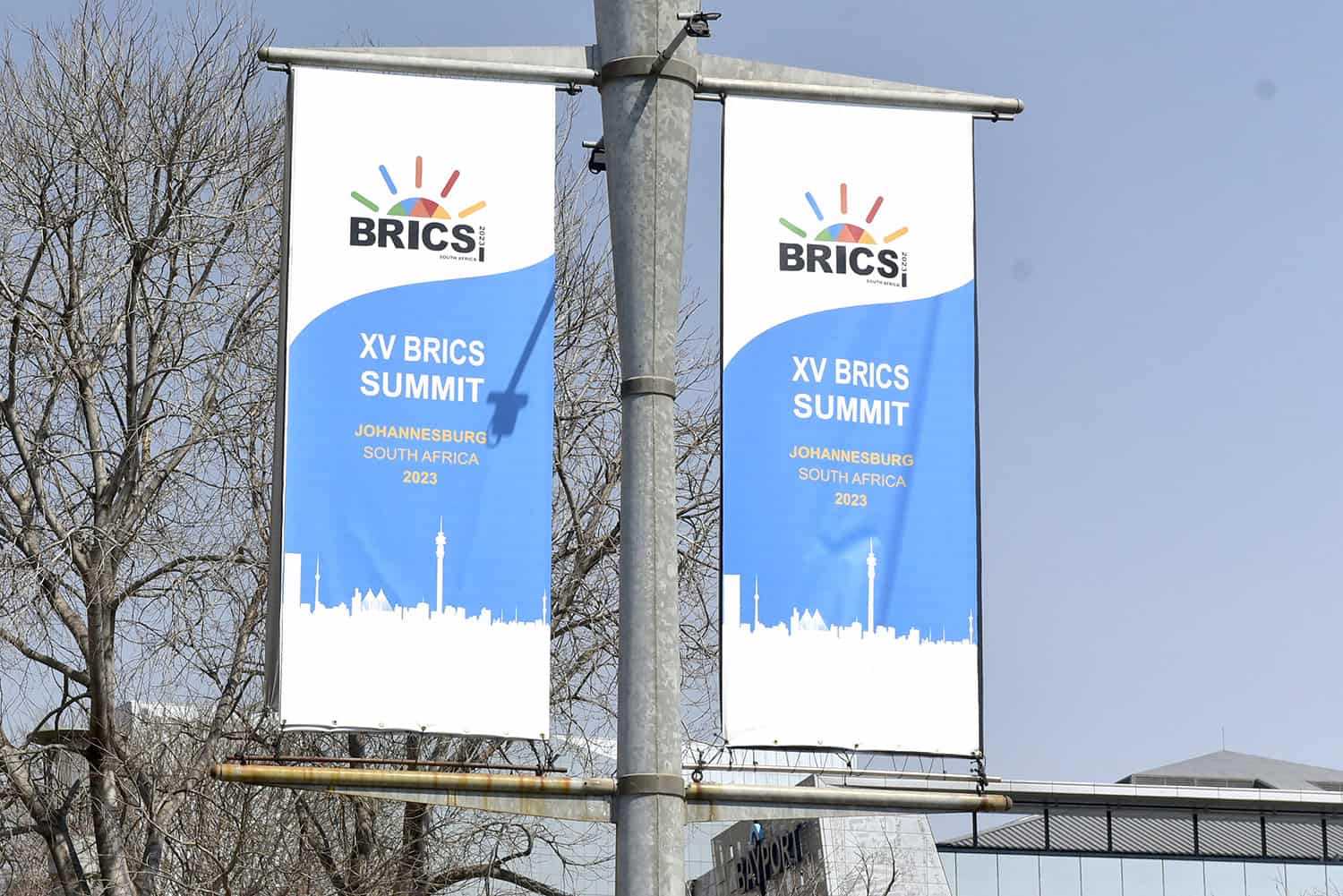
Delegates from the world’s major emerging economies, and dozens of leaders from across the developing world, are meeting in Johannesburg for the BRICS summit started on Tuesday.
At the summit, BRICS leaders discussed alternative currency options to challenge dollar dominance and the possibility of expanding their grouping of five to include other countries.
South African President Cyril Ramaphosa, Chinese President Xi Jinping, Brazil’s President Luiz Inacio Lula da Silva and Indian Prime Minister Narendra Modi are attending in person, while Russia’s Vladimir Putin will make a virtual appearance.
More than 40 leaders from emerging economies will attend meetings on the margins of the summit this year. Many, including Saudi Arabia, Iran, Argentina, Indonesia and Egypt, have expressed interest in joining the bloc.
The theme of this year’s summit, BRICS and Africa: Partnership for Mutually Accelerated Growth, Sustainable Development, and Inclusive Multilateralism, also focuses on Africa.
Ramaphosa has, once again, reiterated South Africa’s position in relation to the expansion of BRICS (Brazil, Russia, India, China, South Africa) calling on the world economies to buy into Africa’s potential.
He addressed delegates at the official opening of the 15th BRICS Summit in Sandton on Tuesday evening.
Ramaphosa said BRICS is growing in its importance and influence in the world. “We will be taking into account the various desires of many countries wanting to be part of BRICS.”
The president added that this year’s summit is expected to be the most significant in the group’s history and could impact Africa’s relationship with other countries and its position globally.
“These factors all position Africa as the next frontier of productivity and growth. The BRICS countries have an opportunity to contribute and participate in Africa’s growth story that can be achieved through greater cooperation in areas such as infrastructure, agriculture, manufacturing, new energy and the digital economy.”
The summit has attracted more than 40 countries who seek to join the bloc and heightened debate on a “BRICS plus” which would include more nations.
Ramaphosa said this would shift raw material trade.
“African countries have made it clear that the investors of choice are those who will come and invest in our continent but also process the resources here close to source. So that African countries do not export rock and sand, but export finished products as we would like to do.”
The five current member countries will have to agree on the criteria for new members before any countries are admitted, but a bigger BRICS is seen as a policy favored by China and Russia.
Putin took multiple shots at the West on the opening day of an economic summit in South Africa, using a prerecorded speech that was aired on giant screens Tuesday to rail at what he called “illegitimate sanctions” on his country and threatening to cut off Ukraine’s grain exports permanently.
Russian president has told the BRICS Business Forum in Sandton that the country was ready to return to the grain deal “only when all obligations to the Russian side have been fulfilled.”
His 17-minute speech recorded in advance centered on the war in Ukraine and Russia’s relationship with the West even though South African officials had said East-West frictions should not dominate the first in-person BRICS summit since before the COVID-19 pandemic and hoped to guide the conversation away from the deteriorating geopolitical climate.
He said the illegitimate sanctions imposed on sovereign states were compounding the world’s socio-economic challenges.
Putin said they were having to deal with challenges amidst the increasing volatility in stock, currency, energy, and food markets coupled with strong inflation pressures.
He said that international economic situations were also seriously affected by the “illegitimate sanction practice and illegal freezing of assets of foreign states, which essentially amounts to the tramping of all the basic norms and rules of free trade”.
Putin said that despite the unlawful sanctions that seriously hindered Russia’s supply of grain, the country is and would continue to remain a responsible supplier of food to the African continent.
He said Russia was being deliberately obstructed in the supply of grain and fertilisers abroad.
“We are hypocritically blamed for the current crisis situation in the world market,” he said.
Chinese president Xi Jingpin also brought an air of confrontation to the Johannesburg summit, saying in a speech read on his behalf by a Chinese government minister minutes after Putin’s address that “some country, obsessed with maintaining its hegemony, has gone out of its way to cripple the emerging markets and developing countries.”
“Whoever is developing fast becomes its target of containment. Whoever is catching up, becomes its target of obstructions,” Chinese Commerce Minister Wang Wentao said while delivering Xi’s speech.
It was a clear reference to the United States and the growing economic friction between the US and China.
Xi is in South Africa for the summit and met with Ramaphosa earlier Tuesday. He didn’t attend the opening-day business forum where the other three BRICS leaders gave their addresses in person. No reason was given for the Chinese leader’s absence.
Indian Prime Minister Narendra Modi said BRICS has risen as a ray of hope for the global economy.
“Despite volatility in the world economy, India is the fastest growing economy. India has converted crises and difficulties into opportunities,” he said.
In his remarks at the business forum, Brazilian President Lula da Silva said he supported the BRICS common currency programme that does not aim to replace the national currency regime.
“I support a common trading currency for BRICS countries that will not replace our national currencies,” he said.
“The New Development Bank already represents a milestone in effective collaboration among emerging economies and is expected to be the global leader in financing projects that address the most pressing challenges of our time,” he added.
“We cannot accept new global colonialism,” he said in his speech, in remarks sure to trigger concerns in the West about Brazil’s position on China’s and Russia’s campaign to stand up against Western hegemony.
Meanwhile the African National Congress (ANC) delegation led by secretary-general Fikile Mbalula, Minister of Minerals and Energy Gwede Mantashe and ANC deputy secretary Nomvula Mokonyane has met with Da Silva for a brief discussion on issues of mutual interest ahead of the official start of the 15th BRICS Summit.
The meeting took place at the Leonardo Hotel, a stone’s throw from the Sandton Convention Centre where the summit is under way this afternoon.
The meeting was also attended by Cosatu and SACP.
Mantashe said the briefing included the issue of de- dollarisation among other matters as well as other inter-party challenges and struggle for anti-imperialism.
“The point of poverty, unemployment formed part of the discussion during this meeting,” Mantashe said.
Addressing some of the pertinent areas of discussion, Mbalula said the wide-ranging meeting did indeed touch on the issue of de-dollarisation and expansion of BRICS as an economic and development block.
“We briefed Da Silva about the BRICS Plus dialogue and some of the important resolutions that we took.
“He did say that the issue of expansion and de-dollarisation will be part of the discussions. It is a very complicated issue but we are determined to look at it and they too will look at it. They did reflect on it,” Mbalula said.
Mbalula said most of the discussion focused on inter-party issues and challenges.
He said as the BRICS Summit begins, it was important for the ANC to build stronger, progressive relations to fend off imperialism.
“We need to build stronger, progressive parties in our respective continents as we bulwark against imperialism and its agenda to subjugate our national and regional interests to those of the Western world.”
The U.S. and EU will be closely monitoring events in Johannesburg, with the long list of countries lining up to join BRICS suggesting that the bloc’s calls for a reorganization of the global governance structure might be hitting home with many.